
CETP Reforms: Speeding Up Cleaner Industry
In a major move to strengthen pollution control and promote
sustainable industrial growth, the Ministry of Environment, Forest and Climate
Change (MoEFCC) has overhauled the regulatory framework for Common Effluent
Treatment Plants (CETPs). The reform aims to speed up the creation of CETPs
across industrial clusters while keeping environmental safeguards and oversight
intact.
CETPs are centralised facilities that treat effluents from
groups of industries, particularly small and medium enterprises that cannot
afford individual treatment systems. They ensure scientific management,
efficient monitoring, and safe disposal of industrial waste. The Central
Pollution Control Board (CPCB) has classified CETPs as Essential Environmental
Services, highlighting their critical role in pollution abatement.
Why reform was needed
Currently, the number and capacity of CETPs fall short of
what industrial clusters require. Delays in establishing CETPs often result in
untreated or poorly treated effluents polluting rivers and groundwater. After
detailed reviews, the Ministry found that CETPs were already heavily regulated
through Consent to Establish (CTE) and Consent to Operate (CTO), periodic
inspections, and online monitoring. Requiring prior Environmental Clearance was
duplicative and caused unnecessary delays.
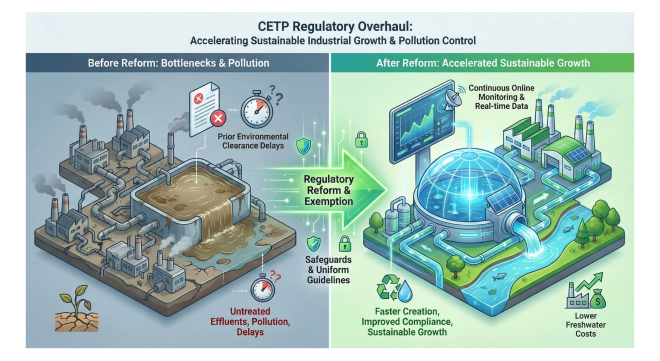
The reform exempts CETPs from prior Environmental Clearance,
provided they implement safeguards and follow Uniform Consent Guidelines and
Environmental Protection Rules (effective September 2025). This change allows
faster creation of CETPs, boosting compliance and improving environmental
outcomes.
Stringent oversight remains
CETPs will still be regulated by State Pollution Control
Boards (SPCBs) and Pollution Control Committees under the Water and Air
Pollution Acts. New safeguards include:
- Conveying effluents only through closed pipelines
- Prohibiting the use of treated water for agriculture
- Continuous online monitoring with real-time data for CPCB and
SPCB
These measures ensure traceability, prevent illegal
discharge, and protect public health and the environment.
Benefits for industry
Faster CETP establishment improves treatment capacity and
compliance. It also enables reuse of treated water, lowering freshwater costs
for industrial clusters. Centralised treatment and professional operation lead
to more efficient and sustainable industrial practices.
By removing bottlenecks without compromising safeguards, the
reform strengthens pollution control infrastructure, aligns with India’s
sustainability goals, and positions industrial clusters, especially textile and
SME-heavy regions, for responsible, compliant, and efficient growth.
Faster CETP establishment improves treatment capacity and compliance. It also enables reuse of treated water, lowering freshwater costs for industrial clusters. Centralised treatment and professional operation lead to more efficient and sustainable industrial practices.
Subscribe To Textile Excellence Print Edition
If you wish to Subscribe to Textile Excellence Print Edition, kindly fill in the below form and we shall get back to you with details.
Newsletter
Subscribe To Textile Excellence Mailing List


- December 09, 2022
'There Is Very High Acceptance For India

- December 09, 2022
'Advanced Machines & Service, Customer C
- October 09, 2023
First-time In The World: Rieter’s Auto

- July 28, 2026
Arvind Eyes Leadership In India's Premiu

- June 01, 2020
Karl Mayer Enables Automated Production

- June 05, 2023
Ultimax - All New Revolutionary Rapier W
- June 09, 2025
DyStar Becomes A Wholly Owned Subsidiary

- July 28, 2026