
`Craft Needs Strategic Branding Support, Alongwith Policy Support’
Padma Yangchan, co-founder of Namza Couture, comes
from Ladakh and brings a deeply rooted perspective to contemporary fashion. Her
work is simple in thought yet rich in meaning, focused on preserving, evolving
and celebrating Ladakh’s textile wisdom. Through Namza, she creates garments
that go beyond being worn—each piece is an experience, carrying memory, land
and identity.
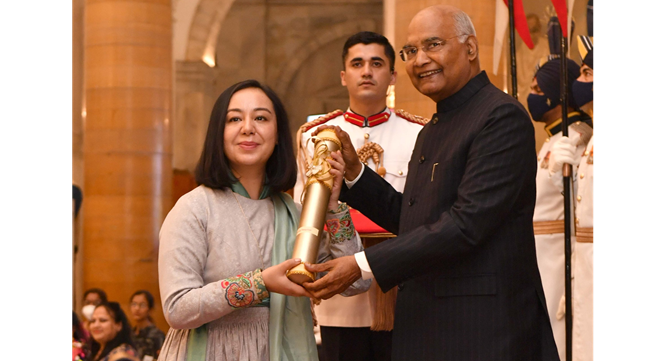
In 2022, she received the Nari Shakti Puraskar from former President Ram Nath Kovind for her work in reviving Ladakh’s lost cuisine and hand-weaving traditions. A designer and café founder, she blends fashion with food and sustainability. Through her work, she is bringing Ladakh’s culture to a wider audience while adapting its craft for global relevance.
Shubhangi Prasad
Your journey with Namza is deeply rooted in Ladakh’s
culture. What was the spark or defining moment that made you choose this path?
The defining moment was returning to Ladakh after living in
Delhi, Mumbai and London. I saw how undervalued our indigenous wool, weaving,
and craft traditions were. Ladakh has raw beauty and deep craftsmanship, yet
little structured design direction or luxury positioning.
Namza was born from the desire to reinterpret our heritage,
not as costume, but as couture.
In today’s competitive Indian textile landscape, what key
opportunities do you see for craft-driven brands like Namza?
I feel India has immense craft diversity, but gaps remain
in:
• Design innovation aligned with global luxury standards
• Consistent quality control
• Branding and storytelling
• Structured artisan development
The opportunity lies in creating craft brands that are
culturally rooted but aesthetically international.
Craft-based production often faces scalability
challenges. Tell us about your experience here.
Craft cannot be rushed. Instead of scaling fast, we scale
mindfully. At Namza Couture we:
• Work with small artisan clusters
• Train artisans in quality benchmarks
• Develop sampling systems before production
• Maintain realistic timelines
We believe that luxury craft requires controlled growth, not mass expansion.
What are some challenges unique to building a
craft-driven luxury brand in a remote region like Ladakh, and how have you
turned those challenges into strengths?
We have faced few challenges, such as:
• Logistics and transportation
• Seasonal production disruptions
• Limited skilled manpower
Our strengths include:
• Authenticity
• Pure raw materials - stories of silk route, pashmina, wool
• Strong cultural identity
Our remoteness is something which gives us narrative power and exclusivity.
India’s textile industry is seeing a strong push toward
sustainability and traceability. How do you integrate these practices while
keeping production viable and commercially sound?
For us, sustainability is not a trend, it is geography.
We use local wool, silk and handwoven textiles, minimize
waste through small-batch production, avoid overproduction, and produce
primarily through offline retail.
Commercial viability comes from positioning our pieces as
heirloom investments, not seasonal commodities.
In Ladakh sustainability is a way of living.
In Ladakh, resources are precious. Nothing is wasted. This
philosophy guides us for making:
• Limited collections
• Long-lasting silhouettes
• Repair-friendly construction
• Slow production cycles
We design for longevity, not trend turnover.
Are there emerging fibres, craft techniques, or
textile innovations from Ladakh that you believe the industry should pay
attention to?
Yes, the textile industry should pay attention to:
• Indigenous Ladakhi sheep wool, Pashima, camel wool
• Yak wool blending
• Traditional backstrap and pit loom weaving adaptations
• Heritage embroidery reinterpretations
These fibres have strong insulation properties and luxury potential when refined through design.
What values guide your leadership? How do you nurture
creativity, cultural sensitivity, and craftsmanship within your team?
I lead with cultural responsibility, discipline, emotional
intelligence, and creative integrity.
I nurture creativity by allowing research time, encouraging
artisans to share stories and ensuring our team understands the cultural
significance behind every motif.
What are the top three operational challenges you face
running a textile-and-craft brand from Ladakh, and how have you built systems
to overcome them?
For us the top operational challenges are:
1. Harsh winters affecting production timelines
2. Logistics and freight costs
3. Skill retention among young artisans
We overcome this by planning seasonal calendars early,
maintaining buffer inventory and investing in artisan training.
As someone who champions traditional textiles, what is
your view on India’s current textile policies, especially regarding handloom,
GI tagging, and export opportunities?
India has made positive strides in handloom recognition and
GI tagging. However, more structured export facilitation and design-led cluster
development are needed.
Craft needs strategic branding support, not just subsidies.
How do you see the future of Indian craft-based fashion
evolving over the next decade?
The next decade will see:
• Traceable luxury
• Region-specific identity branding
• Smaller but stronger craft houses
• International collaborations rooted in authenticity
I believe craft will become the definition of true luxury.
What makes a craft cluster truly successful - community
ownership, market linkage, government support, or design intervention?
I think the strongest clusters combines:
• Community ownership
• Market linkage
• Design intervention &
• Government infrastructure support
All the four pillars must work together for a craft cluster.
What is your advices to young designers and entrepreneurs
who dream of building a brand grounded in culture and sustainability?
For the young designers and entrepreneurs I would say:
Be patient.
Craft takes time.
Do not romanticise culture, first understand it deeply.
Build systems, not just aesthetics.
And remember “discipline sustains creativity.”
As an Indian entrepreneur, what do you feel is your
responsibility towards your nation, textile industry, the community, and the
next generations?
I feel my responsibility is:
• To preserve heritage without dilution
• To generate dignified livelihoods
• To represent Ladakh responsibly
• To inspire younger generations to see value in their roots
For me craft is not nostalgia, it is economic power.
What are your aspirations for Namza?
I envision:
• A global presence for Himalayan luxury
• A structured artisan training centre in Ladakh
• Collaborative capsules with international designers
• A museum-style experiential flagship in Ladakh
Namza should become a cultural landmark, not just a label.
Finally, we would like to know, if Namza Couture had the
opportunity to collaborate with the mainstream textile industry (mills, brands,
designers), what type of partnership would create maximum impact for Ladakh’s
artisans?
For us the most impactful partnership would involve:
• Mills developing refined yarns using Ladakhi wool
• Design houses co-creating capsule collections
• Export houses opening global distribution channels
• Transparent sourcing models benefiting artisans directly
Such partnerships would bring scale without erasing our
identity.
In 2022, she received the Nari Shakti Puraskar from former President Ram Nath Kovind for her work in reviving Ladakh’s lost cuisine and hand-weaving traditions. A designer and café founder, she blends fashion with food and sustainability. Through her work, she is bringing Ladakh’s culture to a wider audience while adapting its craft for global relevance.
Subscribe To Textile Excellence Print Edition
If you wish to Subscribe to Textile Excellence Print Edition, kindly fill in the below form and we shall get back to you with details.
Newsletter
Subscribe To Textile Excellence Mailing List

- December 09, 2022
'There Is Very High Acceptance For India

- December 09, 2022
'Advanced Machines & Service, Customer C
- October 09, 2023
First-time In The World: Rieter’s Auto
- July 28, 2026
Arvind Eyes Leadership In India's Premiu

- June 01, 2020
Karl Mayer Enables Automated Production
- June 05, 2023
Ultimax - All New Revolutionary Rapier W
- June 09, 2025
DyStar Becomes A Wholly Owned Subsidiary
- July 28, 2026