
IIT Gandhinagar Develops Hydrogel “Super Sponge” To Clean Dye-Polluted Wastewater
Researchers at the Indian Institute of Technology
Gandhinagar (IITGN) have developed a hydrogel-based material that can remove
toxic industrial dyes from wastewater with very high efficiency. The work
focuses on a carboxymethyl cellulose (CMC)-based hydrogel designed to act like
a “super sponge” for dye adsorption.
The study, published in ACS Applied Polymer Materials,
targets a major industrial pollution problem. Dye-based industries such as
textiles, leather, paper, cosmetics, and packaging generate large volumes of
wastewater. A significant portion of this wastewater is still released into the
environment with limited treatment, especially in developing economies.
One of the commonly used industrial dyes is methylene
blue. It is widely used in textiles, paper, rubber, silk, wool, and cosmetic
applications. It is also used in some diagnostic applications. However, once
released into water bodies, it can persist for long periods and cause
environmental damage. Exposure to methylene blue-contaminated water has been
linked to health risks such as nausea, breathing issues, eye irritation, and
other toxic effects.
Hydrogel-based solution from IITGN
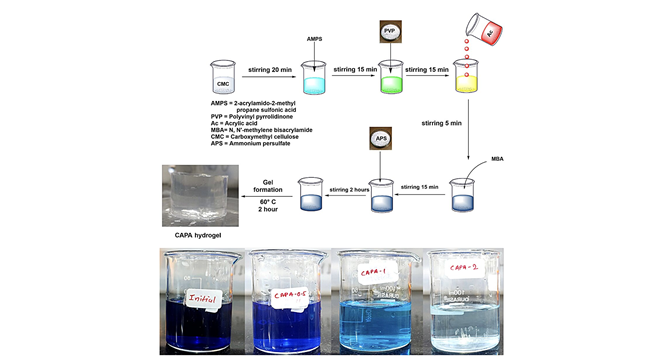
The IITGN team developed a hydrogel called CAPA using
carboxymethyl cellulose, a biodegradable polymer derived from cellulose, along
with acrylic acid and other components. Hydrogels are porous, water-absorbing
materials that can be engineered to trap pollutants.
The researchers created multiple versions of the
material by adjusting the amount of acrylic acid. This adjustment changed the
surface charge and structure of the hydrogel, which directly affected its dye
removal performance.
According to lead researcher Dr. Hitarth Patel, the key
innovation was tuning a single ingredient to improve performance.
High removal efficiency
Among the tested variants, CAPA-2 showed the best
results. It removed 99.6% of methylene blue from water under test conditions.
It also recorded an adsorption capacity of about 475 milligrams of dye per gram
of hydrogel. This is significantly higher than many earlier CMC-based
materials, which typically range between 30 mg/g and 250 mg/g.
The material also showed the ability to remove other
dyes such as crystal violet and rhodamine B, even when present together in the
same solution. This is important because industrial wastewater usually contains
mixed pollutants rather than a single dye.
How it works
The performance of the hydrogel is based on charge
attraction. The material carries negatively charged sites, while methylene blue
and similar dyes carry positive charges. This leads to strong electrostatic
attraction between the dye molecules and the hydrogel surface.
The structure also includes nanoscale pores of around 25
nanometers. These pores help trap dye molecules, which are much smaller in
size. In addition, hydrogen bonding and hydrophobic interactions further
improve dye capture.
CAPA-2 performed well across different conditions. It
maintained strong adsorption in neutral water and also showed stable
performance in acidic and alkaline environments (pH 3 to 10). This is important
for industrial use, where wastewater conditions vary.
Reusability and commercial potential
The hydrogel also showed good reusability. After four
cycles of use, CAPA-2 retained most of its performance, with only a small drop
in efficiency. This is a key factor for cost-effective industrial application.
Researchers say the next step is testing the material in
real industrial wastewater, which contains more complex mixtures of chemicals
and impurities compared to laboratory conditions.
If scaled successfully, such hydrogels could offer a
lower-cost and energy-efficient option for dye removal, especially for textile
and chemical industries facing stricter environmental compliance requirements.
Researchers say the next step is testing the material in real industrial wastewater, which contains more complex mixtures of chemicals and impurities compared to laboratory conditions. If scaled successfully, such hydrogels could offer a lower-cost and energy-efficient option for dye removal, especially for textile and chemical industries facing stricter environmental compliance requirements.
Subscribe To Textile Excellence Print Edition
If you wish to Subscribe to Textile Excellence Print Edition, kindly fill in the below form and we shall get back to you with details.
Newsletter
Subscribe To Textile Excellence Mailing List


- December 09, 2022
'There Is Very High Acceptance For India

- December 09, 2022
'Advanced Machines & Service, Customer C
- October 09, 2023
First-time In The World: Rieter’s Auto

- July 28, 2026
Arvind Eyes Leadership In India's Premiu
- June 01, 2020
Karl Mayer Enables Automated Production
- June 05, 2023
Ultimax - All New Revolutionary Rapier W
- June 09, 2025
DyStar Becomes A Wholly Owned Subsidiary

- July 28, 2026