
How The Indian Textile Industry Can Benefit From The ₹2,400 Crore Job Incentive Scheme
A major push for first-time jobs and
industry hiring
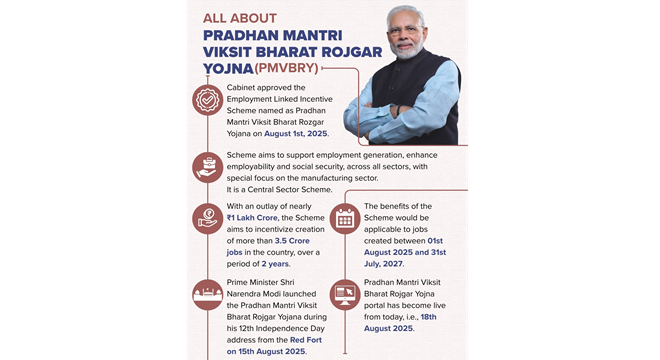
The Government of India has disbursed around ₹2,400
crore under the Pradhan Mantri Viksit Bharat Rozgar Yojana (PM-VBRY). The
scheme is designed to support job creation across sectors by encouraging
companies to hire first-time employees and by providing financial incentives
linked to employment.
Prime Minister Narendra Modi described the scheme as a
bridge between young job seekers and industry. The idea is simple. Young people
entering their first job get support, and companies that create new jobs also
receive encouragement. According to the government, the scheme has already
helped generate around 15 lakh employment opportunities, while expanding social
security coverage for new workers.
This is not a sector-specific programme. It is a broad
employment initiative. But for labour-intensive industries like textiles, the
impact is more direct than it first appears.
How the scheme is structured
The core focus of the scheme is to formalise and expand
employment at the entry level. It targets first-time employees and links
incentives to their sustained participation in the workforce. Workers who
complete an initial period in their first job become eligible for benefits,
while employers who create new jobs also receive support.
The government has positioned this as a joint framework
that benefits both sides of the labour market. It is not just about job
creation numbers. It is about improving the transition from informal work to
formal employment, with social security coverage included in the process.
Why it matters for the textile sector
The textile and apparel industry is one of India’s
largest employment generators. It relies heavily on first-time workers,
especially in garment manufacturing, stitching units, processing houses and
MSME clusters.
Because of this structure, the scheme has a natural
connection with the sector. Many textile units face a constant challenge of
hiring and retaining entry-level workers. Labour turnover is high, and training
cycles are short. The availability of steady new workers often determines how
quickly a factory can respond to export orders.
By incentivising first-time employment, the scheme can
improve the flow of workers into textile units. It does not change production
economics directly, but it reduces friction in labour availability, which is a
critical constraint for the industry.
A step towards a more formal workforce
One of the key objectives of the scheme is to expand
social security coverage and bring more workers into the formal economy. This
is particularly relevant for textiles, where a large portion of the workforce
still operates in informal or semi-formal arrangements.
Greater formalisation can improve worker retention and
compliance. It also aligns better with global buyer expectations, especially in
export markets where traceability, labour standards and compliance frameworks
are becoming increasingly important.
Indirect impact on productivity and
competitiveness
Prime Minister Modi has repeatedly emphasised that
India’s future competitiveness will depend on skilled talent, high-quality
standards and innovation. These themes are central to the scheme as well, even
though it is framed as an employment initiative.
For the textile industry, this translates into a
longer-term shift. As more workers enter formal employment and gain structured
work experience, factories may find it easier to build trained teams and
maintain consistent quality levels. This becomes especially important in
export-oriented segments such as garments, home textiles and made-ups, where
buyers expect reliability and scale.
What it means in practical terms
For textile manufacturers, especially MSMEs and garment
exporters, the most important outcome is improved access to entry-level labour
and a gradual shift towards a more formal, stable workforce. This supports
expansion when export demand rises and reduces one of the sector’s
long-standing operational constraints.
Prime Minister Narendra Modi described the scheme as a bridge between young job seekers and industry. The idea is simple. Young people entering their first job get support, and companies that create new jobs also receive encouragement. According to the government, the scheme has already helped generate around 15 lakh employment opportunities, while expanding social security coverage for new workers. This is not a sector-specific programme. It is a broad employment initiative. But for labour-intensive industries like textiles, the impact is more direct than it first appears.
Subscribe To Textile Excellence Print Edition
If you wish to Subscribe to Textile Excellence Print Edition, kindly fill in the below form and we shall get back to you with details.
Newsletter
Subscribe To Textile Excellence Mailing List


- December 09, 2022
'There Is Very High Acceptance For India

- December 09, 2022
'Advanced Machines & Service, Customer C
- October 09, 2023
First-time In The World: Rieter’s Auto

- July 28, 2026
Arvind Eyes Leadership In India's Premiu

- June 01, 2020
Karl Mayer Enables Automated Production

- June 05, 2023
Ultimax - All New Revolutionary Rapier W
- June 09, 2025
DyStar Becomes A Wholly Owned Subsidiary

- July 28, 2026