
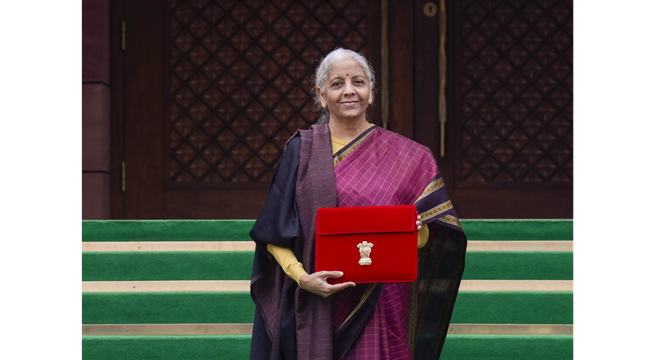
Union Budget 2027 Continues With Fiscal Discipline And Incremental Reforms
Fiscal consolidation stays on track
Debt-to-GDP eases to 55.6% in 2026–27; fiscal deficit down
to 4.3%.
Lower interest burden = more headroom for capex and sectoral support.
Big Spend, Capex-Led Growth
- Total
expenditure (FY27): ₹53.5 lakh crore
- Capex:
~₹11 lakh crore
Textiles – Integrated Support Framework
-
National Fibre Scheme for self-reliance
in natural fibres such as silk, wool and jute, man-made fibres, and new-age
fibres;
-
Textile Expansion and Employment Scheme
to modernise traditional clusters with capital support for machinery,
technology upgradation and common testing and certification centres;
-
National Handloom and Handicraft programme
to integrate and strengthen existing schemes and ensure targeted support for
weavers and artisans;
-
Tex-Eco Initiative to promote globally
competitive and sustainable textiles and apparels;
-
Samarth 2.0 to modernise and upgrade the
textile skilling ecosystem through collaboration with industry and academic
institutions.
-
Mega Textile Parks in challenge mode to
build textile and technical textile production capacity and capability in
value-addition.
-
Mahatma Gandhi Gram Swaraj initiative to
strengthen khadi, handloom and handicrafts, in market linkages and branding.
The focus will also be on training, skilling, quality of processes and
production. The initiative will weavers, village industries,
One-District–One-Product initiative and rural youth.
Related sector boost
Chemical manufacturing: To strengthen domestic
chemical production and cut import dependence, the government will support
States in setting up three dedicated Chemical Parks through a challenge-based,
cluster-driven plug-and-play model, aimed at faster project execution and scale
efficiencies.
Machinery & Capital Goods: To improve
productivity and quality across industries, Hi-Tech Tool Rooms will be set up
by CPSEs at two locations as digitally enabled, automated service centres,
enabling local design, testing and cost-efficient manufacturing of
high-precision components at scale.
Focus on sports goods - A dedicated initiative for
sports goods that will promote manufacturing, research and innovation in
equipment design as well as material sciences.
Support for SMEs, MSMEs continues
“Champion SMEs” and supporting micro enterprises: A
three-pronged approach to help SMEs and MSMEs
- A dedicated ₹10,000 crore SME Growth Fund, to create
future Champions, incentivizing enterprises based on select criteria.
- Self-Reliant India Fund set up in 2021, with ₹2,000 crore
to continue support to micro enterprises and maintain their access to risk
capital.
- MSME Liquidity via TReDS: With over ₹7 lakh
crore already facilitated through TReDS, the government will deepen its use by
mandating TReDS for all CPSE purchases from MSMEs, providing CGTMSE-backed
credit guarantees for invoice discounting, linking GeM with TReDS to enable
faster and cheaper financing, and securitising TReDS receivables to create a
secondary market and improve liquidity.
`Corporate Mitras’ – Government has proposed to
facilitate professional institutions such as ICAI, ICSI, ICMAI to design
short-term, modular courses and practical tools to develop a cadre of
‘Corporate Mitras’, especially in Tier-II and Tier-III towns. These accredited
para-professionals will help MSMEs meet compliance requirements at affordable
costs.
Sustainable Cargo & Logistics: To promote greener
freight movement, the government will build a Dedicated Freight Corridor from
Dankuni to Surat, operationalise 20 new National Waterways over five years
starting with NW-5 in Odisha, set up regional training centres and inland
ship-repair hubs at Varanasi and Patna, and launch a Coastal Cargo Promotion
Scheme to raise the share of inland waterways and coastal shipping from 6% to
12% by 2047.
MAT Reform and Corporate Tax Clarity
-
Companies can use brought-forward MAT credit
only if they opt for the new corporate tax regime, with set-off capped at 25%
of tax liability.
-
MAT to become a final tax from 1 April 2026,
with no new MAT credit accumulation thereafter.
-
MAT rate reduced to 14% from 15%; existing MAT
credit accumulated till 31 March 2026 will remain available for set-off under
the new rules.
Other benefits
Export Flexibility for Textiles & Leather:
Exporters of textile and leather garments, footwear and related products will
get up to one year (instead of six months) to complete exports of final
products, easing compliance pressure amid weak and volatile global demand.
SEZ Relief for Manufacturers: As a one-time measure,
eligible manufacturing units in SEZs will be allowed to sell a limited portion
of their output in the domestic market at concessional duty rates to improve
capacity utilisation during global trade disruptions, while maintaining a level
playing field with DTA units.
Ease Of Doing Business
-
Single Digital Clearance Window: All
approvals required for cargo clearance will move to a single, integrated
digital window by the end of the financial year.
-
Faster Customs Clearance: For goods with
no compliance requirements, Customs will allow immediate clearance once online
registration is completed and duties are paid, cutting dwell time at ports.
-
Integrated Customs Platform: A Customs
Integrated System (CIS) will be rolled out over two years as a unified platform
for all customs processes, improving speed, transparency and scalability.
-
E-commerce Exports Boost: The ₹10 lakh
per consignment cap on courier exports is removed, enabling small businesses,
artisans and start-ups to ship higher-value goods abroad. Handling of returns
and rejected consignments will also be streamlined using technology.
Exporters of textile and leather garments, footwear and related products will get up to one year (instead of six months) to complete exports of final products, easing compliance pressure amid weak and volatile global demand.
Subscribe To Textile Excellence Print Edition
If you wish to Subscribe to Textile Excellence Print Edition, kindly fill in the below form and we shall get back to you with details.
Newsletter
Subscribe To Textile Excellence Mailing List

- December 09, 2022
'There Is Very High Acceptance For India

- December 09, 2022
'Advanced Machines & Service, Customer C
- October 09, 2023
First-time In The World: Rieter’s Auto
- July 28, 2026
Arvind Eyes Leadership In India's Premiu

- June 01, 2020
Karl Mayer Enables Automated Production
- June 05, 2023
Ultimax - All New Revolutionary Rapier W
- June 09, 2025
DyStar Becomes A Wholly Owned Subsidiary
- July 28, 2026