
India’s Big Regulatory Reset: What It Means Ahead Of The World Bank’s 2026 B-READY Test
What does it actually take to make it easier to start a
factory, move goods across states, hire workers, get environmental clearances,
resolve disputes and scale a business without drowning in paperwork?
For India, the answer over the past decade has been simple
but ambitious: rewrite the rulebook.
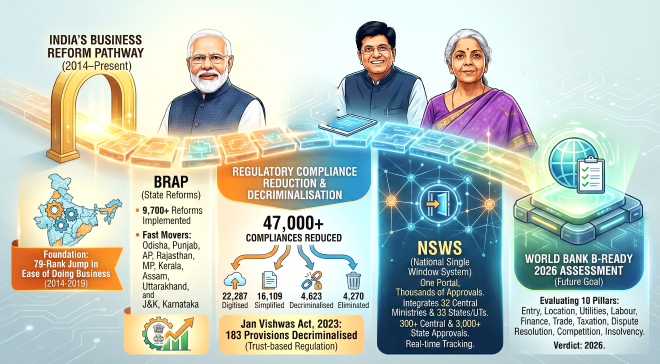
Between 2014 and 2019, India climbed 79 places in the World
Bank’s Ease of Doing Business rankings, reaching 63rd position. Then the
rankings were discontinued. But the reform momentum did not slow. Instead, it
shifted gears.
In 2024, the World Bank introduced a new framework -
Business Ready (B-READY) — a far more granular assessment covering 10 pillars
across the entire business lifecycle: entry, location, utilities, labour,
finance, trade, taxation, dispute resolution, competition and insolvency. India
will be assessed in the third B-READY report due in 2026.
This time, the evaluation is broader. And India has been
preparing.
Reform as competition: States join the race
The reform push has not been limited to New Delhi. It has
played out across India’s states through the Business Reforms Action Plan
(BRAP), launched in 2014 by DPIIT.
Seven editions later, more than 9,700 reforms have been
implemented across States and Union Territories.
The changes are not cosmetic. They include:
• Single-window
clearance systems
• Simplified
building and environmental approvals
• Digitised
registrations and renewals
• Risk-based
inspection systems
• Faster
utility connections
• GIS-based
industrial land banks integrated with the India Industrial Land Bank
BRAP rankings have turned regulatory reform into competitive
federalism. States are classified as Top Achievers, Achievers, Fast Movers or
Aspirers based on implementation levels.
In BRAP 2024 (including compliance burden reforms), Fast
Movers in Category Y include Odisha, Punjab, Andhra Pradesh, Rajasthan, Madhya
Pradesh, Kerala, Assam, Uttarakhand, Jammu & Kashmir and Karnataka.
Category X includes northeastern states (excluding Assam) and certain UTs.
The message: reform is no longer concentrated in a few
industrial powerhouses. It is spreading geographically.
The compliance clean-up: 47,000 rules reduced
If BRAP focused on systems, the Regulatory Compliance Burden
(RCB) initiative tackled volume.
Since 2020, over 47,000 compliances have been reduced across
ministries and states.
The breakdown is significant:
• 16,109
simplified
• 22,287
digitised
• 4,623
decriminalised
• 4,270
eliminated entirely
Under RCB+, 4,846 out of 6,262 compliances across 23
commonly implemented Acts have been rationalised to reduce overlap across
states.
DPIIT also mapped more than 42,000 reduced compliances
across over 670 Acts to identify duplication and harmonise frameworks
nationwide.
For businesses, this means fewer repetitive filings, fewer
overlapping approvals and lower transaction friction — especially for firms
operating in multiple states.
Decriminalisation: Changing the tone of regulation
One of the most consequential shifts has been philosophical.
The Jan Vishwas (Amendment of Provisions) Act, 2023
decriminalised 183 provisions across 42 Acts administered by 19 Ministries.
Imprisonment clauses for minor procedural lapses were removed, and several
offences were converted into civil penalties with compounding options.
The reform is now expanding.
The Jan Vishwas (Amendments of Provisions) Bill, 2025,
currently under review, proposes amendment of 355 provisions across 16 Central
Acts administered by 10 Ministries. Of these, 288 provisions are proposed for
decriminalisation to strengthen ease of doing business, and 67 aim to improve
ease of living.
The objective is clear: shift from punitive oversight to
trust-based regulation, without diluting accountability.
One portal, thousands of approvals
Parallel to legal reforms, digital integration has
accelerated.
The National Single Window System (NSWS) now integrates:
• 32 Central
Ministries/Departments
• 33
States/UTs
• 300+
Central approvals
• 3,000+
State approvals
Through an Investor Dashboard, businesses can track
application status in real time. A helpline and daily grievance mechanism
support users.
Instead of navigating fragmented departmental interfaces,
firms can move through a unified digital gateway.
What 2026 will test
The upcoming B-READY assessment in 2026 will evaluate how
well these reforms function across the full business lifecycle — not just on
paper, but in practice.
It will measure:
• How easy it
is to start operations
• How
predictable tax and labour systems are
• How
efficiently trade procedures work
• How
disputes and insolvency cases are handled
• How
competitive markets remain
In other words, it will test whether India’s regulatory
reset has moved from reform announcements to institutional outcomes.
A structural shift, not a ranking exercise
What stands out is scale.
More than 9,700 state-level reforms.
Over 47,000 compliances reduced.
Hundreds of legal provisions decriminalised.
Thousands of approvals integrated digitally.
Taken together, these are not incremental tweaks. They
represent a systemic attempt to redesign the interface between government and
enterprise.
As India approaches the 2026 B-READY evaluation, the real
question is no longer whether reforms are being attempted. It is whether the
accumulated digital, legal and procedural changes have fundamentally lowered
the cost and complexity of doing business.
The verdict will come in 2026.
But the groundwork - expansive, data-heavy and structurally
ambitious - is already in motion.
As India approaches the 2026 B-READY evaluation, the real question is no longer whether reforms are being attempted. It is whether the accumulated digital, legal and procedural changes have fundamentally lowered the cost and complexity of doing business. The verdict will come in 2026.
Subscribe To Textile Excellence Print Edition
If you wish to Subscribe to Textile Excellence Print Edition, kindly fill in the below form and we shall get back to you with details.
Newsletter
Subscribe To Textile Excellence Mailing List

- December 09, 2022
'There Is Very High Acceptance For India

- December 09, 2022
'Advanced Machines & Service, Customer C
- October 09, 2023
First-time In The World: Rieter’s Auto
- July 28, 2026
Arvind Eyes Leadership In India's Premiu

- June 01, 2020
Karl Mayer Enables Automated Production
- June 05, 2023
Ultimax - All New Revolutionary Rapier W
- June 09, 2025
DyStar Becomes A Wholly Owned Subsidiary
- July 28, 2026