

Bangladesh Pilot Proves 85% Textile Wastewater Can Be Recycled
A
major breakthrough has just emerged from Bangladesh, and it strikes at the
heart of one of the textile industry’s biggest problems: water pollution.
An
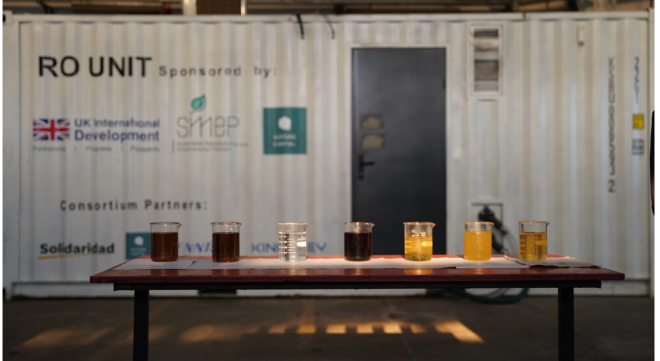
SMEP-funded pilot project has demonstrated that up to 85% of textile wastewater
can be recycled inside a working mill.
The
project brings together Solidaridad Network Asia and QStone Capital BV,
combining advanced wastewater treatment with an innovative financing model
designed to make large-scale adoption commercially viable. The results were
presented to industry stakeholders earlier this month in a technical webinar
outlining the pilot outcomes.
At
the centre of the breakthrough is a modular 5 m³ per hour pilot plant installed
at Zaber & Zubair Fabrics Ltd, a vertically integrated textile mills in
Dhaka. The system was designed and manufactured by Lenntech Water Solutions and
installed by Kingsley Engineering Services Corporation.
The
plant uses a rigorous three-stage treatment process: ultrafiltration, dual
reverse osmosis, and advanced oxidation. Together, these technologies treat and
recycle process water back into production. The difficult part, according to
the technical team, is not recycling the water. It is managing the highly
concentrated residual stream known as brine. The project has developed
segment-specific solutions for three textile categories: dyeing factories,
denim washing units, and sweater washing facilities.
The
economics are equally significant. For a system operating at 70% recycling with
30% brine management, operational costs range between $0.12 and $0.30 per cubic
metre of recycled water. A full-scale 100 m³ per hour plant would require
capital investment between $0.9 million and $2 million.
Following
successful trials in Dhaka, the mobile modular unit will now be relocated to
Designer Fashion Ltd of the Bengal Group for testing in a denim washing
facility. Performance data from both installations will be consolidated into a
comprehensive technical evaluation covering two distinct wastewater profiles.
A
1% surcharge that could reshape textile water economics
The
technology is bold. The financing model may be even bolder.
Alongside
the wastewater breakthrough, consortium partner QStone Capital BV has proposed
a new funding mechanism inspired by carbon markets, but focused on water.
The
idea is simple. Add a 1% voluntary surcharge at retail on garments produced
using verified water-efficient and pollution-avoidance systems. That 1% could
become a powerful engine for industrial change.
Here
is how it works.
At
checkout, consumers would have the option to contribute an additional 1% - much
like opting to buy a shopping bag. The garment would carry a label indicating
that it was produced under verified water stewardship standards. The surcharge
would be voluntary. The impact would be measurable.
On
the factory side, avoided water pollution would be independently verified and
issued as blockchain-based digital certificates, water credits or tokens. These
digital records would confirm that real pollution reduction occurred at source.
The
funds collected at retail would flow into an independent foundation or
financing vehicle. That pool of capital would then subsidise factories
transitioning to advanced wastewater recycling and zero liquid discharge
systems. In short, consumers would directly help finance cleaner production.
According
to QStone Capital’s CEO Jeroen Tielman, “The model creates a bridge between
shoppers and supply chains. It turns sustainability from a compliance cost into
a shared value mechanism.”
QStone
estimates that in Bangladesh alone, such a 1% surcharge could generate up to
US$ 700 million annually. That level of capital could accelerate water
recycling infrastructure across one of the world’s largest garment
manufacturing hubs.
Consumer
appetite appears to support the model. Surveys conducted across Europe and
Australia suggest buyers are willing to pay 3–4% more for sustainably produced
garments. Against that backdrop, a 1% opt-in contribution appears commercially
realistic.
If
implemented at scale, this approach could fundamentally change how
environmental upgrades are financed in textiles. Instead of relying solely on
factory margins or brand mandates, the transition to cleaner production could
be co-funded at the point of sale.
Turning
water treatment into verified, tradeable value
This
model is built on full transparency at the factory level. Every cubic metre of
wastewater treated. Every litre reused. Every discharge avoided. All verified.
All recorded.
At
the core of the system are Internet-of-Things sensors installed across the
treatment process. These sensors continuously monitor flow rates, recycling
volumes and discharge data. The data is automatically converted into
tamper-proof digital certificates called Avoidance of Water Pollution Tokens.
These
are not marketing claims. They are blockchain-based records that confirm
wastewater has been treated and reused instead of discharged into the
environment.
Each
token represents verified pollution avoided at source.
This
creates a transparent bridge between factories, brands and consumers.
The
implications are significant. These digital certificates can be traded.
Factories can use them to help repay financing for wastewater infrastructure.
Brands can use them to offset water footprints with independently verified
data. Institutional investors can participate in sustainable production with
measurable impact.
The
system embeds accountability directly into the supply chain without disrupting
existing commercial relationships. Brands continue to source. Mills continue to
produce. But now, environmental performance becomes a quantifiable asset.
QStone
is actively seeking partnerships with major fashion brands and financial
institutions to scale the model - first across Bangladesh, then potentially
into other textile hubs.
Moving
into Phase Two
The
SMEP pilot now moves into Phase Two: achieving zero liquid discharge without
evaporation systems, cutting both costs and environmental impact further.
Results from the denim washing trial are expected within a month. If
successful, this model could become a global blueprint - aligning consumers,
brands, factories and investors around shared responsibility for water
stewardship.
Water
bankruptcy: A crisis at the edge
The
textile industry is approaching a dangerous tipping point. Global water
scarcity is no longer a distant threat. It is an operational risk. Experts now
warn of “water bankruptcy” in major garment-producing nations.
Bangladesh,
India, Pakistan and China - together responsible for most of the world’s
apparel output - are under severe water stress. Textile manufacturing is one of
the most water-intensive and polluting industries. Dyeing and finishing alone
account for roughly 20% of global industrial water pollution. Untreated
wastewater carries toxic dyes, heavy metals and chemical residues into rivers,
groundwater and farmland.
In
Bangladesh, where ready-made garments generate more than 80% of export
earnings, the stakes are existential. Rivers such as the Buriganga, Turag and
Shitalakkhya receive heavy effluent loads. Monitoring data shows biochemical
oxygen demand, chemical oxygen demand and toxic metals frequently exceeding
safe limits. Water becomes biologically dead and economically unusable.
This
is what water-risk experts call quantity failure and quality failure. Aquifers
are depleted faster than they recharge. Rivers lose their capacity to absorb
pollution.
The
choice between economic growth and clean water is becoming stark.
Yet
collapse is not inevitable. Advanced water reuse and zero liquid discharge
systems offer a path forward. With coordinated investment and supply chain
commitment, textile hubs can reduce freshwater withdrawal, cut pollution at
source and protect both communities and long-term industry viability.
According to QStone Capital’s CEO Jeroen Tielman, “The model creates a bridge between shoppers and supply chains. It turns sustainability from a compliance cost into a shared value mechanism.” QStone estimates that in Bangladesh alone, such a 1% surcharge could generate up to US$ 700 million annually. That level of capital could accelerate water recycling infrastructure across one of the world’s largest garment manufacturing hubs. Consumer appetite appears to support the model. Surveys conducted across Europe and Australia suggest buyers are willing to pay 3–4% more for sustainably produced garments. Against that backdrop, a 1% opt-in contribution appears commercially realistic.
Subscribe To Textile Excellence Print Edition
If you wish to Subscribe to Textile Excellence Print Edition, kindly fill in the below form and we shall get back to you with details.
Newsletter
Subscribe To Textile Excellence Mailing List

- December 09, 2022
'There Is Very High Acceptance For India

- December 09, 2022
'Advanced Machines & Service, Customer C
- October 09, 2023
First-time In The World: Rieter’s Auto

- July 28, 2026
Arvind Eyes Leadership In India's Premiu

- June 01, 2020
Karl Mayer Enables Automated Production
- June 05, 2023
Ultimax - All New Revolutionary Rapier W

- June 09, 2025
DyStar Becomes A Wholly Owned Subsidiary

- July 28, 2026