
Why Fashion Is Less Circular Than Ever, And What It’ll Take To Change Course
Over
the last decade, circularity has been one of the loudest conversations in the
textile industry. Today, resale platforms are growing, innovative solutions are
gaining traction and circular business models are headlining innovation
reports. On the surface, it looks like the industry is beginning to close the
loop. In reality, it’s still wide open. To really make circularity work, we
first need to rethink how we invest, regulate, create demand and design
circular value chains.
Circularity
is not only about fibres, fabrics, technologies and innovations. It’s also
about the people who collect, sort and process materials.
In
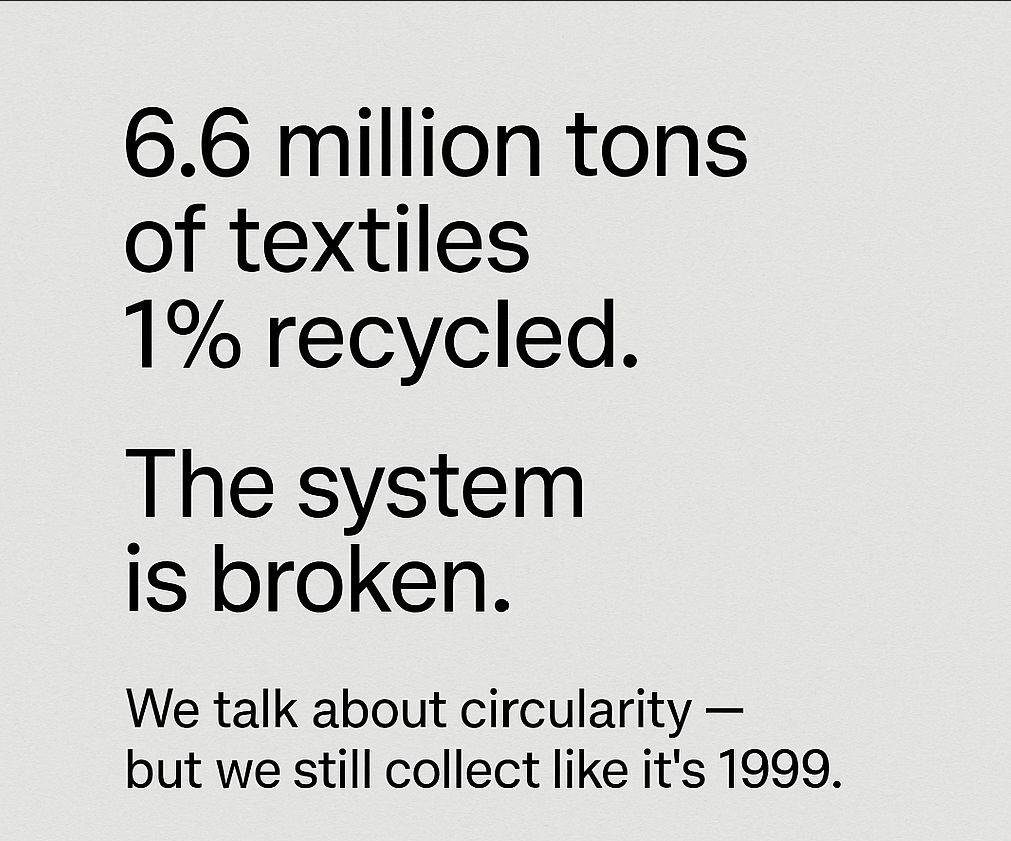
2024, the textile industry produced close to 132 million tonnes of textile
fibre, which is more than double its volume compared to 2000 (Materials Market
Report 2025). At the opposite end of the value chain, there are billions of
garments going to landfill or incineration every year, and less than 1% of the
materials being recycled back into new garments (A New Textiles Economy:
Redesigning fashion’s future).
Measured
against how fast we produce, buy and discard, the textile industry is – in
material terms – less circular than ever.
And circularity is not only about fibres, fabrics, technologies and
innovations. It’s also about the people who collect, sort and process
materials. And that work is still, in many countries, informal, insecure and
unsafe.
For
most of history, clothes were used in circular ways without anyone calling it
circularity. Wardrobes were small, fabrics valuable, and garments were worn,
repaired and passed on until there was almost nothing left. With
industrialisation and global supply chains, that logic flipped. As production
scaled and prices went down, fashion shifted from scarcity to abundance.
Making
this global, high-volume system circular is far harder than simply going back
to how clothes were used before. According to the Circularity Gap Report
Textiles, by Circular Economy, today’s textile economy is structurally linear.
Capital, policy and purchasing decisions still favour virgin production.
Without shifting those incentives, circular solutions struggle to scale.
Circularity
isn’t new, the system is
In
the early 2010s, circularity was still a novel topic in the industry.
Organisations like the Ellen MacArthur Foundation helped change that. The
Foundation’s 2017 report A New Textiles Economy gave the entire industry a
tangible blueprint on how to design products to be used more, made to be made
again, and created from safe and renewable inputs. Since then, resale has moved
from niche to mainstream and textile-to-textile recyclers have left the lab.
As
Mark Buckley, Fashion and Textiles Lead at the Ellen MacArthur Foundation, puts
it:
“In
2017, circularity was an idea. Today, it’s a business imperative. It has
captured the creativity and commercial ambition of an industry ready for
reinvention. The shift that matters most isn’t any one technology or business
model, it’s in how the industry thinks. In a world of fragmenting supply chains
and resource pressure, the case for circularity has never been stronger.”
While
progress is taking place, the last few years have seen momentum hit a speed
bump, and in many markets, circularity is at risk of becoming a buzzword
instead of business model. This, however, doesn’t mean circularity has failed.
It means we’ve learned more about how complex it really is. While systems
change is possible, it takes time, patience and the right incentives for every
part of the value chain, including the current informal workforce involved in
circular value chains, from collectors and sorters to recyclers, manufacturers
and brands.
To
make circularity work, there are three questions that need to be solved: How we
invest, how we regulate and how we increase demand.
1.
Increase investments in scalable solutions
Recent
years have shown that circularity can create successful businesses, and those
businesses have shown that it’s sometimes easier to reinvent the wheel than to
fix the one we have. Resale is an example of this: platforms like Vestaire
Collective, Vinted and Sellpy have gone mainstream, proving that extending
product life can be commercially viable. Textile-to-textile recyclers such as
Ambercycle, Syre and Circulose show that lowcarbon fibres made from textile
waste can be competitive. The more capital that flows into solutions with a
clear path to scale, the faster circularity can move from small pilots to
industry-level impact.
2.
Make circularity the rational choice through legislation
The
EU’s new textile rules, from Extended Producer Responsibility to ecodesign and
stricter controls on waste and green claims, point in this direction. Policy
can level the playing field for brands and make it increasingly expensive to
rely on virgin, fossilbased materials with no circular pathway.
But
regulation alone will not deliver transformation. Policy must be paired with
clear timelines, financing and capacity-building, otherwise smaller
manufacturers and brands risk being pushed out rather than supported to adapt.
Strong rules matter, but so does enabling the industry to comply.
3.
Secure demand from brands and value-chain partners
Demand
must come from brands and value chain partners, not only from consumers.
Circular solutions scale when brands set timebound targets, build multiyear
partnerships with circular actors, and let circularity influence decisions on
assortment, margins and risk.
Upstream
partners also need clear, consistent signals to justify changing how they
operate.
When
capital, regulations and demand inside the system all pull in the same
direction, circularity can move from trend to transformation. To get there,
brands, policymakers and investors must begin turning pilot projects into
long‑term commitments, and treating circularity not as an add‑on, but as a
functioning operating system ready for hard launch.

As Mark Buckley, Fashion and Textiles Lead at the Ellen MacArthur Foundation, puts it: “In 2017, circularity was an idea. Today, it’s a business imperative. It has captured the creativity and commercial ambition of an industry ready for reinvention. The shift that matters most isn’t any one technology or business model, it’s in how the industry thinks. In a world of fragmenting supply chains and resource pressure, the case for circularity has never been stronger.”
Subscribe To Textile Excellence Print Edition
If you wish to Subscribe to Textile Excellence Print Edition, kindly fill in the below form and we shall get back to you with details.
Newsletter
Subscribe To Textile Excellence Mailing List


- December 09, 2022
'There Is Very High Acceptance For India

- December 09, 2022
'Advanced Machines & Service, Customer C
- October 09, 2023
First-time In The World: Rieter’s Auto

- July 28, 2026
Arvind Eyes Leadership In India's Premiu

- June 01, 2020
Karl Mayer Enables Automated Production
- June 05, 2023
Ultimax - All New Revolutionary Rapier W

- June 09, 2025
DyStar Becomes A Wholly Owned Subsidiary

- July 28, 2026