
India’s Recycling Capital Struggles Under Growing Waste Crisis
Nestled
in Haryana, the Panipat textile cluster, often called India’s “cast-off
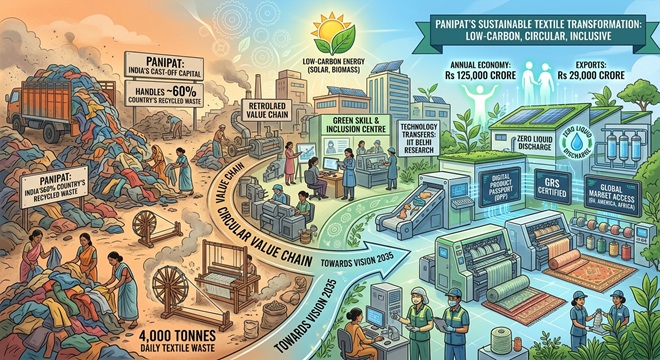
capital”, handles nearly 60% of the country’s recycled textile waste.
Contributing around Rs 125,000 crore (Euro 12.5 billion) annually to the
national textile economy, including exports of Rs 29,000 crore (Euro 2.9
billion), Panipat supplies recycled yarns, blankets, carpets, and home
furnishings to markets across Europe, America, the Middle East, and Africa.
Yet,
this economic vibrancy comes with challenges. Outdated machinery,
energy-intensive processes, and high carbon emissions risk trade barriers as
global regulations like the EU Green Deal, ESPR, and CBAM tighten environmental
norms. The cluster also faces social vulnerabilities, with most of its 4.5
lakh-strong workforce employed informally; 30–40% are women working in
labour-intensive sorting, finishing, and stitching roles, often without social
protections or fair wages.
Panipat’s
6,400 micro, small, and medium enterprises process nearly 4,000 tonnes of
textile waste daily, including a large portion of imported waste from Europe,
Asia, and North America. The industrial footprint spans 2,400 square
kilometres, with zones specialising in sorting, spinning, and dyeing.
Environmentally,
the cluster shows mixed progress. While many dyeing units have switched from
coal to biomass or LPG, energy efficiency and effluent treatment vary widely.
Digital traceability is limited, with only select export-oriented units using
certifications like GRS and GOTS. A shared Digital Product Passport (DPP)
system could soon become a market necessity under EU mandates.
The
study identifies key barriers to decarbonisation: obsolete machinery, high
investment costs, fragmented governance, low environmental awareness, and
gendered exclusion from skills training. Workforce development is crucial;
women remain underrepresented in higher-skill roles, with limited access to
formal training in energy management, machine efficiency, or occupational
safety.
Financial
and institutional support is uneven. Few MSMEs access public green finance,
while engagement with R&D institutions remains limited. Incremental
technology upgrades, mechanised sorting, soft-flow dyeing, and high-speed looms
show promise but are not yet widespread.
Looking
ahead, the report envisions Panipat as India’s first low-carbon, circular, and
socially inclusive textile recycling cluster by 2035. Key strategies include
promoting renewable energy, water and chemical management, establishing
automated sorting and upcycling hubs, training workers through a Green Skill
and Inclusion Centre, developing cluster-wide digital traceability, and
creating a Decarbonisation and Resource Efficiency Cell to drive public–private
collaboration.
Innovations
and solutions underway
Despite
these challenges, the report highlights multiple innovations and progressive
developments across technology, institutional practices, and market engagement.
Technology
transfers and research collaborations
Advanced
recycling technologies are beginning to penetrate the cluster. Initiatives by
institutions like IIT Delhi’s Atal Centre for Textile Recycling and
Sustainability have led to the transfer of scientific methods for handling
complex waste streams, including high‑performance aramid materials and legacy
textiles that are hard to recycle through conventional means.
Partial
renewable energy adoption
Some
enterprises have transitioned from coal to biomass or LPG, and there is nascent
adoption of solar power for energy needs. Though not yet widespread, renewable
energy use, coupled with energy audits and process benchmarking, is emerging as
a practical intervention to reduce carbon intensity.
Traceability
initiatives
Export‑oriented
units have adopted partial traceability systems to meet buyer demands. The
concept of a Digital Product Passport (DPP) is gaining traction in the cluster
as a future compliance tool under global circular economy mandates. Businesses
are exploring cluster‑wide traceability and blockchain applications to document
recycled content, material flows, and environmental credentials, a strategic
shift from informal record‑keeping to digital readiness.
Skills
development and inclusion projects
Efforts
to formalise skills training are underway, with stakeholders recognising the
need for structured green jobs training, especially in energy management,
process control, and occupational health. Some NGOs and industry associations
are piloting worker safety awareness and informal worker registration
programmes to connect workers with formal benefits and protections.
Supply
chain upgrades
Innovation
in sorting and integration of new feedstock handling techniques are being
piloted. Improving sorting efficiency is critical, as accurate fibre separation
enhances the quality of recycled outputs and enables higher‑value recycling
rather than low‑grade downcycling.
Strategic
Roadmap: Towards a low‑carbon, circular, and inclusive hub
The
study articulates a clear strategic vision: Panipat should become India’s first
low‑carbon, circular, and socially inclusive textile recycling cluster by 2035.
It lays out multi‑pronged priorities to achieve this.
Energy
and process decarbonisation
-
Promote renewable energy (solar, biomass)
and implement energy audits.
-
Retrofit boilers to improve combustion
efficiency.
-
Encourage innovations like low‑liquor dyeing
technologies and energy‑efficient processing equipment.
These
steps can reduce greenhouse gas emissions and align Panipat’s operations with
global sustainability norms.
Water
and chemical management
-
Scale zero liquid discharge (ZLD) systems
across dyeing and finishing units.
-
Promote water‑efficient technologies and low
or dye‑free processes.
-
Strengthen ETP operations through enhanced
training and maintenance.
Improving
water use efficiency and effluent quality is essential for environmental
compliance and community well‑being.
Circular
value chain integration
-
Establish automated sorting facilities and
fibre recovery hubs to improve quality and throughput.
-
Support upcycling enterprises that can
derive higher‑value products from textile waste.
-
Facilitate collaborations for dealing with
blended or synthetic materials that are otherwise hard to recycle.
-
Stronger value chain integration will reduce
material leakage and enhance output quality.
Workforce
development
-
Set up a dedicated Green Skill and Inclusion
Centre for training workers in sustainable production, energy management, and
machine operation.
-
Implement occupational health and safety
(OHS) programmes and social protection literacy.
-
Promote gender inclusion by facilitating
women’s participation in technical roles and leadership positions.
A
skilled and protected workforce is critical for transitioning to higher‑value
recycling and operational excellence.
Digital
and traceability systems
-
Develop a cluster‑wide traceability platform
linked with DPP compliance.
-
Equip MSMEs with digital record‑keeping
tools and certifications to meet buyer requirements.
-
Leverage data for quality control,
environmental reporting, and market access.
Digital
readiness will enable Panipat to retain competitiveness in global value chains.
Institutional
coordination and finance
-
Form a Decarbonisation and Resource
Efficiency Cell (DREC) under a cluster special purpose vehicle (SPV) to
coordinate public–private efforts.
-
Mobilise blended finance schemes, green
bonds, and concessional loans for MSMEs.
-
Strengthen industry association capacity to
advocate and implement sustainable practices.
Coordinated
institutional frameworks and financing support will help overcome resource
constraints and implementation bottlenecks.
Panipat’s
journey reflects the delicate balance of economic growth, environmental
responsibility, and social equity—a microcosm of India’s circular textile
future.
Coordinated institutional frameworks and financing support will help overcome resource constraints and implementation bottlenecks. Panipat’s journey reflects the delicate balance of economic growth, environmental responsibility, and social equity—a microcosm of India’s circular textile future.
Subscribe To Textile Excellence Print Edition
If you wish to Subscribe to Textile Excellence Print Edition, kindly fill in the below form and we shall get back to you with details.
Newsletter
Subscribe To Textile Excellence Mailing List

- December 09, 2022
'There Is Very High Acceptance For India

- December 09, 2022
'Advanced Machines & Service, Customer C
- October 09, 2023
First-time In The World: Rieter’s Auto

- July 28, 2026
Arvind Eyes Leadership In India's Premiu

- June 01, 2020
Karl Mayer Enables Automated Production

- June 05, 2023
Ultimax - All New Revolutionary Rapier W
- June 09, 2025
DyStar Becomes A Wholly Owned Subsidiary
- July 28, 2026