
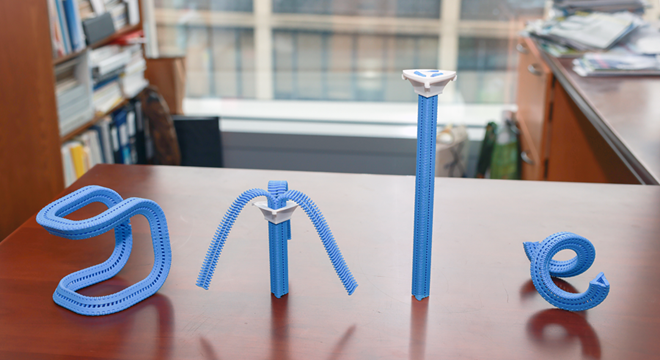
MIT Revives 40-Year-Old ‘Y-Zipper’ Idea For Smart Textiles And Adaptive Structures
A 40-year-old invention has found new life at the Massachusetts Institute of Technology, where researchers have developed a three-sided "Y-zipper" that can transform flexible materials into rigid structures at the pull of a zip. The concept was originally patented in 1985 by MIT professor William Freeman, who envisioned a triangular zipper capable of turning soft products such as tents, bags and furniture into stable, load-bearing forms. At the time, manufacturing technology was not advanced enough to make the idea practical. Now, researchers at MIT's Computer Science and Artificial Intelligence Laboratory (CSAIL), led by postdoctoral researcher Jiaji Li, have combined 3D printing and digital design tools to bring the concept to life. Unlike conventional zippers that simply join two pieces of fabric, the Y-zipper connects three strips. When zipped, the structure automatically changes shape, becoming rigid and capable of supporting loads. Users can digitally design zippers that form straight, curved, coiled or twisted structures depending on the application. The technology could open new possibilities for technical textiles and wearable products. MIT researchers demonstrated a wrist support that can remain flexible during the day and be tightened into a rigid brace when needed. The system could also simplify the assembly of tents and temporary shelters, reducing setup time significantly. Beyond textiles, the Y-zipper could be integrated into adaptive robots, deployable structures and even emergency relief shelters. Researchers also envision future versions made from stronger materials such as metals. Durability tests showed the prototypes could withstand around 18,000 zip-and-unzip cycles before failure, highlighting their potential for repeated use. For the textile sector, the innovation points towards a future where fabrics and textile structures can dynamically switch between soft and rigid states, creating new opportunities in sportswear, medical textiles, outdoor equipment and smart products. The research was presented at the ACM Conference on Human Factors in Computing Systems (CHI) and involved collaborators from Tianjin University, Zhejiang University, Technical University of Munich and Keio University.
The technology could open new possibilities for technical textiles and wearable products. MIT researchers demonstrated a wrist support that can remain flexible during the day and be tightened into a rigid brace when needed. The system could also simplify the assembly of tents and temporary shelters, reducing setup time significantly.
Subscribe To Textile Excellence Print Edition
If you wish to Subscribe to Textile Excellence Print Edition, kindly fill in the below form and we shall get back to you with details.
Newsletter
Subscribe To Textile Excellence Mailing List


- December 09, 2022
'There Is Very High Acceptance For India

- December 09, 2022
'Advanced Machines & Service, Customer C
- October 09, 2023
First-time In The World: Rieter’s Auto

- July 28, 2026
Arvind Eyes Leadership In India's Premiu
- June 01, 2020
Karl Mayer Enables Automated Production
- June 05, 2023
Ultimax - All New Revolutionary Rapier W

- June 09, 2025
DyStar Becomes A Wholly Owned Subsidiary

- July 28, 2026