
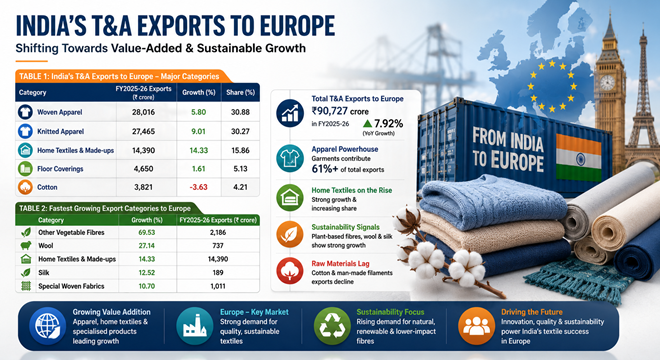
India's Textile & Apparel Exports To Europe Near ₹91,000 Crore In FY2025-26
India's textile and apparel exports to Europe continued their growth trajectory in FY2025-26, rising 7.92% to ₹90,727 crore from ₹84,069 crore in the previous fiscal year. While the headline figure points to another year of healthy expansion, a closer look at the data reveals a more significant trend: Europe's sourcing basket is gradually shifting towards value-added products, with apparel, home textiles and emerging fibre categories driving growth. The shift towards value addition The latest export data suggests that growth is increasingly coming from products higher up the value chain. The strongest-performing categories in Europe in FY2025-26 were garments, home textiles and several niche fibre segments, while a number of traditional raw material categories either stagnated or declined. Apparel remains the cornerstone of India's textile exports to Europe. Knitted and woven garments together account for more than 61% of all textile and apparel exports to the region, making Europe one of India's most important markets for value-added textile products. Home textiles continue to gain ground Home textiles emerged as another bright spot during the year. The category expanded at a faster pace than overall exports and increased its share of India's export basket to Europe. Sustainability signals One of the most interesting developments in FY2025-26 was the sharp rise in exports of plant-based fibres such as flax, hemp and similar materials. Wool and silk exports also recorded strong growth during the year. Although these categories remain relatively small in value terms, their rapid expansion may reflect evolving sourcing preferences within Europe. Sustainability, traceability and circularity have become increasingly important considerations for European brands and retailers, creating opportunities for natural, renewable and lower-impact fibre alternatives. While it is too early to describe this as a structural shift, the data suggests that Indian exporters are beginning to benefit from changing consumer preferences and sustainability-driven sourcing strategies. Raw material exports lose momentum The picture was less encouraging for some traditional fibre categories. Cotton exports to Europe declined during FY2025-26, while exports of man-made filaments also contracted. The contrasting performance between fibres and finished products highlights an important trend. Growth is increasingly being generated by garments, home textiles and specialised products, while commodity-oriented categories are accounting for a smaller share of export expansion.
The picture was less encouraging for some traditional fibre categories. Cotton exports to Europe declined during FY2025-26, while exports of man-made filaments also contracted. The contrasting performance between fibres and finished products highlights an important trend. Growth is increasingly being generated by garments, home textiles and specialised products, while commodity-oriented categories are accounting for a smaller share of export expansion.
Subscribe To Textile Excellence Print Edition
If you wish to Subscribe to Textile Excellence Print Edition, kindly fill in the below form and we shall get back to you with details.
Newsletter
Subscribe To Textile Excellence Mailing List


- December 09, 2022
'There Is Very High Acceptance For India

- December 09, 2022
'Advanced Machines & Service, Customer C
- October 09, 2023
First-time In The World: Rieter’s Auto

- July 28, 2026
Arvind Eyes Leadership In India's Premiu

- June 01, 2020
Karl Mayer Enables Automated Production

- June 05, 2023
Ultimax - All New Revolutionary Rapier W
- June 09, 2025
DyStar Becomes A Wholly Owned Subsidiary

- July 28, 2026