
Anti-Dumping Duty Paralysis Threatens India's Fibre Industry, Says New Report
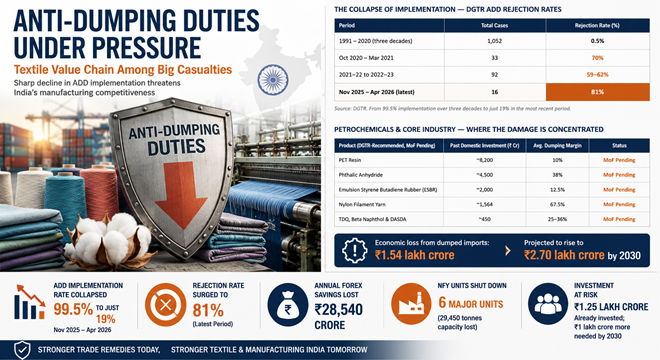
A sharp decline in the implementation of anti-dumping duties (ADDs) is putting India's manufacturing sector under growing pressure, with the textile value chain emerging as one of the major casualties, according to a new report by the Centre for Digital Economy Policy Research (C-DEP) and the Centre for WTO Studies. The report, titled Impact of Anti-Dumping Duties in India, argues that while the Directorate General of Trade Remedies (DGTR) continues to investigate cases and recommend duties against unfairly priced imports, an increasing number of these recommendations are not being notified by the Ministry of Finance. The numbers are striking. 99.5% collapse in ADD implementation rate According to the report, India's ADD implementation rate has collapsed from 99.5% over the three decades between 1991 and 2020 to just 19% in the period between November 2025 and April 2026. During the same period, the rejection rate surged to 81%, compared to just 0.5% historically. The report estimates that non-implementation of pending anti-dumping duties is costing India ₹28,540 crore annually in forgone foreign exchange savings. It also estimates the current economic loss from dumped imports at ₹1.54 lakh crore, a figure projected to rise to nearly ₹2.70 lakh crore by 2030 if current trends continue. Textile value chain is impacted For the textile industry, the findings are particularly significant. Among the products awaiting action are Nylon Filament Yarn (NFY), a key raw material used across a wide range of textile applications. The report claims that six major NFY manufacturing units with a combined capacity of 29,450 tonnes have already shut down. These include facilities operated by Modipon, JCT, Shree Synthetics, GNL, SRF and BRC. The report also highlights closures among sublimation-transfer paper manufacturers, with more than 20 MSMEs reportedly shutting operations under pressure from low-priced imports. According to the study, the damage is concentrated in sectors such as petrochemicals, polymers, fibres and specialty chemicals - industries that form the backbone of India's textile and technical textile ecosystem. Pending ADD cases include products such as PET Resin, Phthalic Anhydride, Emulsion Styrene Butadiene Rubber (ESBR) and Nylon Filament Yarn, where domestic manufacturing capacity already exists. ADD does not lead to inflation One of the report's central arguments challenges the commonly cited concern that anti-dumping duties fuel inflation. Analysing 56 cases where DGTR recommended duties that were ultimately not implemented, the study found that the median impact on final consumer prices would have been just 0.023%. More than 91% of the cases would have resulted in a price increase of less than 0.10%. The report further claims that all 21 pending ADD recommendations combined would contribute less than 0.01 percentage points to inflation, even under conservative assumptions. Most of these products are industrial intermediates rather than consumer goods. Investment, jobs and competitiveness at stake Beyond individual sectors, the report raises broader concerns about India's industrial competitiveness. It notes that India's trade deficit with China reached US$ 99.1 billion in FY2024-25. At the same time, it estimates that approximately ₹1.25 lakh crore has already been invested in domestic manufacturing capacity, with another ₹1 lakh crore required by 2030. Industry fears that uncertainty over trade-remedy implementation could discourage future investments. The report also points to India's relatively restrained use of anti-dumping measures. India's average ADD duration stands at 6.97 years, compared with a global average of 11.19 years. Typical Indian duties range between 5% and 12%, far below levels imposed by several major economies. Calling for urgent action, the report recommends immediate notification of pending DGTR-recommended duties, particularly in petrochemicals, polymers, fibres and other intermediate products. It also seeks a transparent and publicly documented process whenever recommendations are rejected. For textile manufacturers already grappling with volatile demand, rising costs and intensifying global competition, the report delivers a clear warning: protecting domestic capacity today could determine whether India strengthens or weakens its position in the fibre and textile value chain over the coming decade.
Calling for urgent action, the report recommends immediate notification of pending DGTR-recommended duties, particularly in petrochemicals, polymers, fibres and other intermediate products. It also seeks a transparent and publicly documented process whenever recommendations are rejected. For textile manufacturers already grappling with volatile demand, rising costs and intensifying global competition, the report delivers a clear warning: protecting domestic capacity today could determine whether India strengthens or weakens its position in the fibre and textile value chain over the coming decade.
Subscribe To Textile Excellence Print Edition
If you wish to Subscribe to Textile Excellence Print Edition, kindly fill in the below form and we shall get back to you with details.
Newsletter
Subscribe To Textile Excellence Mailing List


- December 09, 2022
'There Is Very High Acceptance For India

- December 09, 2022
'Advanced Machines & Service, Customer C

- October 09, 2023
First-time In The World: Rieter’s Auto

- July 28, 2026
Arvind Eyes Leadership In India's Premiu

- June 01, 2020
Karl Mayer Enables Automated Production

- June 05, 2023
Ultimax - All New Revolutionary Rapier W
- June 09, 2025
DyStar Becomes A Wholly Owned Subsidiary

- July 28, 2026