
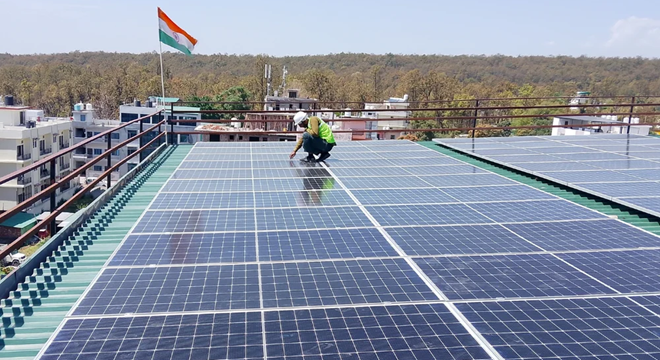
Can Solar Solve Textiles’ Biggest MSME Pain Point? Rooftop Shift Gains Momentum
Rising electricity costs, unstable power supply, and
margin pressure are pushing India’s textile MSMEs toward a new answer: rooftop
solar. Across major textile hubs, solar is fast shifting from an alternative
energy source to a core operational strategy.
India’s textile industry contributes over 2.3% to GDP
and supports 45 million+ jobs, according to the Press Information Bureau. But
for thousands of MSMEs, energy has quietly become one of the biggest threats to
profitability.
Energy crisis tightening margins
In textile clusters such as Surat, Tiruppur, Coimbatore
and Ludhiana, manufacturing runs on continuous power-intensive processes -
spinning, weaving, dyeing and finishing.
But MSMEs are facing a triple squeeze:
-Rising
industrial electricity tariffs
-Unplanned
power cuts
-Heavy
dependence on diesel backup
Energy is no longer just a utility bill. It now directly
impacts cost per kg, delivery timelines, and export competitiveness.
Why solar fits textiles naturally
Unlike many industries, textiles operate largely during
daylight hours with stable load patterns—making them structurally suited for
solar adoption.
Rooftop solar is now enabling:
-30%–70% reduction in electricity costs
-3–5 year payback periods
-Immediate savings from the first billing cycle
-Protection from future tariff shocks
Because consumption is predictable, solar systems can be
used efficiently year-round, improving return on investment for MSMEs.
The real barriers: money, roofs, and dust
Despite strong economics, adoption is not frictionless.
High upfront cost
Working-capital constraints remain a major hurdle.
Financing models and EMI-linked structures are increasingly being used to shift
MSMEs from unpredictable bills to fixed monthly payments.
Complex industrial rooftops
Skylights, vents and structural limitations complicate
installation. Advanced module design and engineering solutions are being used
to maximise output without disrupting factory operations.
Dust-heavy environments
Cotton lint, fibre dust and humidity can reduce efficiency if unmanaged. Installations now include:
-Anti-soiling modules
-Corrosion-resistant structures
-Preventive maintenance schedules
-Robotic cleaning systems (optional)
Power continuity risks
Even short outages can disrupt spinning and damage yarn
quality. Hybrid solar systems with battery storage are being deployed to keep
critical machines running and reduce diesel dependence.
Early adopters report sharp savings
MSMEs already using rooftop solar are seeing measurable
gains:
-Sanmaan
Exports Pvt Ltd: ~71% reduction in electricity costs
-Uma
Sai Woven Sacks: ~44% power cost savings
-Usha
Spincoat: improved production stability due to
reliable power
Beyond cost savings: operational shift
Solar is increasingly influencing how textile units
operate, not just how they save.
It is enabling:
-Lower
manufacturing costs per unit
-Fewer
production interruptions
-Reduced
reliance on diesel generators
-More
stable long-term planning
Export pressure adds urgency
Global buyers are tightening sustainability requirements
through frameworks such as:
-GOTS
-Oeko-Tex
-ZDHC
-Higg
Index
For export-driven MSMEs, solar adoption is becoming part
of compliance, credibility, and buyer access, not just cost control.
Financial upside strengthens the case
Beyond savings, rooftop solar offers tax and capital
advantages:
-Up
to 40% accelerated depreciation (WDV)
-Lower
taxable income
-25+
year lifecycle cost benefits
-Predictable
energy expenditure over decades
Few infrastructure upgrades simultaneously reduce costs
and improve financial efficiency at this scale.
The execution factor
For MSMEs, performance depends heavily on installation
quality and after-sales support. Large-scale EPC players are increasingly
driving adoption with end-to-end execution models, spanning design,
installation, monitoring, and maintenance.
Bottomline: from option to strategy
For textile MSMEs, electricity is no longer a background
cost, it is a core competitiveness factor.
Rooftop solar is emerging as a direct response to that
shift, addressing three pressures at once:
-Cost
inflation
-Power
instability
-Export
sustainability demands
What began as an energy alternative is now turning into
a manufacturing strategy built around control, continuity, and long-term
resilience.
For MSMEs, performance depends heavily on installation quality and after-sales support. Large-scale EPC players are increasingly driving adoption with end-to-end execution models, spanning design, installation, monitoring, and maintenance.
Subscribe To Textile Excellence Print Edition
If you wish to Subscribe to Textile Excellence Print Edition, kindly fill in the below form and we shall get back to you with details.
Newsletter
Subscribe To Textile Excellence Mailing List

- December 09, 2022
'There Is Very High Acceptance For India

- December 09, 2022
'Advanced Machines & Service, Customer C
- October 09, 2023
First-time In The World: Rieter’s Auto

- July 28, 2026
Arvind Eyes Leadership In India's Premiu

- June 01, 2020
Karl Mayer Enables Automated Production
- June 05, 2023
Ultimax - All New Revolutionary Rapier W
- June 09, 2025
DyStar Becomes A Wholly Owned Subsidiary

- July 28, 2026