
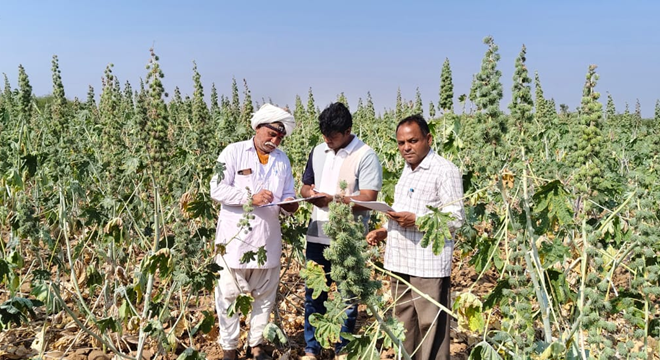
Gujarat Taps Its Abundant Castor Crop To Expand Eri Silk Production
India's
efforts to expand sustainable silk production have reached Gujarat, with the
Ministry of Textiles and the Central Silk Board (CSB) pushing for the
large-scale promotion of castor-based Eri sericulture in the state.
Smt.
Arti Kanwar, Additional Secretary, Ministry of Textiles, and Shri P. Sivakumar,
Member Secretary, CSB, met Gujarat Chief Minister Shri Bhupendra Patel to
review ongoing initiatives and discuss scaling up Eri silk production using
Gujarat's abundant castor crop.
Unlike
conventional mulberry silk, Eri silk is produced by silkworms reared on castor
leaves. Known for its soft, warm and durable texture, Eri silk is increasingly
gaining attention as a sustainable natural fibre with growing domestic and
international demand.
The
Gujarat initiative is part of the Centre's broader strategy to diversify
India's sericulture sector, improve farmer incomes and reduce dependence on
imported silk. In recent years, the Ministry of Textiles has been exploring
castor-based Eri sericulture in new regions to unlock additional livelihood
opportunities and strengthen domestic silk production.
India
is the world's second-largest silk producer, with sericulture supporting around
9.2 million livelihoods across more than 52,000 villages. The country produces
all four major natural silks - Mulberry, Eri, Tasar and Muga - yet continues to
import raw silk to meet rising domestic demand from the textile and fashion
industries.
To
strengthen the sector further, the Central Silk Board is promoting scientific
farming practices through its 'Mera Resham Mera Abhimaan' (MRMA) campaign. The
initiative encourages sericulturists to adopt improved technologies,
sustainable production methods and modern cultivation practices to enhance
productivity and silk quality.
By
leveraging Gujarat's extensive castor cultivation, the Ministry hopes to create
a new growth engine for India's silk industry while generating additional rural
employment and expanding the country's sustainable fibre basket. As global
demand shifts towards eco-friendly textiles, castor-based Eri silk could emerge
as an important addition to India's natural fibre portfolio.
To strengthen the sector further, the Central Silk Board is promoting scientific farming practices through its 'Mera Resham Mera Abhimaan' (MRMA) campaign. The initiative encourages sericulturists to adopt improved technologies, sustainable production methods and modern cultivation practices to enhance productivity and silk quality. By leveraging Gujarat's extensive castor cultivation, the Ministry hopes to create a new growth engine for India's silk industry while generating additional rural employment and expanding the country's sustainable fibre basket. As global demand shifts towards eco-friendly textiles, castor-based Eri silk could emerge as an important addition to India's natural fibre portfolio.
Subscribe To Textile Excellence Print Edition
If you wish to Subscribe to Textile Excellence Print Edition, kindly fill in the below form and we shall get back to you with details.
Newsletter
Subscribe To Textile Excellence Mailing List


- December 09, 2022
'There Is Very High Acceptance For India

- December 09, 2022
'Advanced Machines & Service, Customer C
- October 09, 2023
First-time In The World: Rieter’s Auto

- July 28, 2026
Arvind Eyes Leadership In India's Premiu

- June 01, 2020
Karl Mayer Enables Automated Production

- June 05, 2023
Ultimax - All New Revolutionary Rapier W

- June 09, 2025
DyStar Becomes A Wholly Owned Subsidiary

- July 28, 2026