
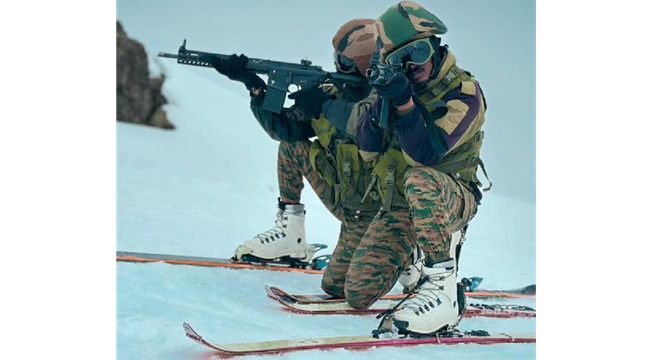
DRDO MoU With Uttar Pradesh Textile Tech Institute Signals Big Push For Defence Textiles
India's
defence textile ecosystem has received a major boost with the Defence Materials
and Stores Research & Development Establishment (DMSRDE), a DRDO
laboratory, signing a Memorandum of Understanding (MoU) with the Uttar Pradesh
Textile Technology Institute (UPTTI), Kanpur to jointly develop next-generation
textile technologies for both defence and civilian applications.
The
partnership will combine DRDO's expertise in defence materials with UPTTI's
textile research capabilities to develop advanced, high-performance fabrics and
technical textiles. The two institutions will jointly undertake research
projects, share scientific knowledge, laboratory infrastructure and technical
expertise, helping accelerate the development of innovative textile solutions.
The
agreement was signed at the UPTTI campus by Dr. Kingsuk Mukhopadhyay, Director,
DMSRDE, and Prof. (Dr.) G. Nalankilli, Director, UPTTI, in the presence of
senior scientists and officials from both organisations.
The
collaboration is expected to strengthen India's capabilities in advanced
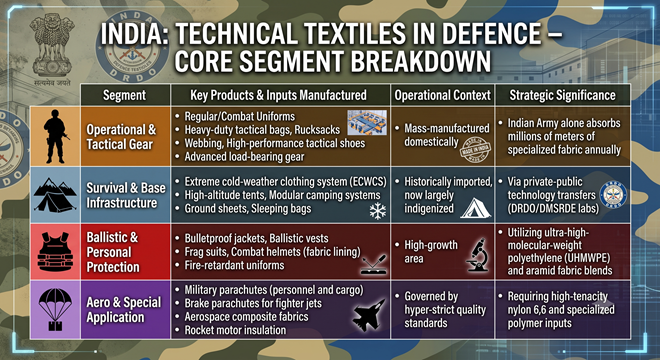
defence textiles, including protective clothing, ballistic materials,
specialised fabrics and other high-performance textile applications, while also
creating technologies that can be adapted for civilian use.
The
development comes at a time when India's defence manufacturing ecosystem is
expanding rapidly, creating significant opportunities for the technical
textiles sector.
The
Uttar Pradesh Defence Industrial Corridor has already attracted investment
proposals worth ₹35,526.76 crore, with 62 companies allotted land across six
nodes - Kanpur, Jhansi, Lucknow, Aligarh, Agra and Chitrakoot. Nine
manufacturing units have already commenced production.
Kanpur
has emerged as the largest investment destination in the corridor, attracting
₹12,803 crore. The city is also becoming a hub for defence materials, with
companies such as AR Polymers manufacturing ballistic materials and Adhunik
Materials producing defence textiles.
India’s
current manufacturing prowess in defence textiles
- The technical textile foundation:
India's overall technical textiles market size is estimated at US$ 22.7
billion in 2026. The Ministry of Textiles projects it to scale rapidly to US$
50 billion over the next five years.
- Protech & defense share:
Defense-related protective textiles account for roughly 10% to 12% of this
larger ecosystem, placing the domestic defense textile manufacturing value
at an estimated US$ 2.2-2.7 billion (₹18,000 crore to ₹22,000 crore).
- The procurement pipeline:
This sector feeds into India's soaring domestic defense production, which
reached a historic peak of ₹1.78 lakh crore in the 2025–26 financial year.
Key growth drivers
·
Positive indigenisation lists:
The Ministry of Defence has banned the import of thousands of line items,
forcing local procurement of everything from high-altitude socks to complete
parachute assemblies.
- The National Technical Textiles Mission
(NTTM): Backed by an outlay of ₹1,480 crore,
the NTTM focuses aggressively on the domestic raw material supply chain
(such as carbon fibers, aramid yarns, and high-performance nylon) to
eliminate reliance on foreign chemical inputs.
- Global export push:
Beyond domestic supply, Indian defense textile manufacturers are emerging
as major global exporters, feeding into India's overall defense export
surge to ₹23,622 crore in FY25.
India
has emerged as a global powerhouse in the production of ballistic gear. The
country transitions from importing protective gear to being a major exporter to
over 100 nations, including several NATO members.
Some
leading private sector players
A
mix of pioneering private giants and cutting-edge specialists drive the
production of ballistic jackets, tactical helmets, and armored plates in India.
MKU Limited (Kanpur, Uttar Pradesh)
Headquartered
in Kanpur, MKU Limited is one of the world's largest exporters of personal
armor. It protects over 3 million soldiers globally. The company developed the
proprietary "GEN-6" ballistic technology, which reduces body armor
weight by 40% and thickness by 30%. It successfully manufactured and delivered
over 1.59 lakh MUKUT ballistic helmets to the Indian Army to replace heavy,
older-generation gear.
MKU
Limited operates production units in India alongside an advanced, in-house
ballistic testing laboratory in Germany.
SMPP
Limited (New Delhi / Palwal)
SMPP
Limited specialises in lightweight personal armor using Boron Carbide Ceramic.
This material ranks among the lightest and hardest solutions for defeating
armor-piercing steel-core bullets. The company won a major indigenous contract
to supply 1.86 lakh modular, 360-degree protective bulletproof jackets directly
to the Indian Army. Beyond vests, they
specialise in platform protection kits for military aircraft, patrol boats, and
tactical vehicles.
Indian
Armour Systems Pvt. Ltd. (Haryana)
Based
outside New Delhi, Indian Armour controls its entire workflow vertically. They
manage the process directly from yarn weaving up to the final tactical garment
assembly. The company produces a massive volume of NIJ-certified hard armor
panels, bomb suppression blankets, and full de-mining protective suits.
Indian
Armour Systems is a regular supplier of premium tactical body armor to law
enforcement and federal agencies across the EU, Middle East, and Africa.
Adhunik
Materials (Anuradha Group)
Adhunik
focused aggressively on backward integration to manufacture ballistic-grade
technical fabrics entirely within India. By establishing an in-house fabric
line, they broke the monopoly of Western chemical suppliers. This ensures India
has an uncompromised, localised raw material supply chain for composite armor.
India’s
ballistic gear moves towards advanced material science
India’s
defense textile and ballistic gear segment has shifted from low-tech
manufacturing to advanced material science. Collaborations between organisations
like the Defence Research and Development Organisation (DRDO), the Bhabha
Atomic Research Centre (BARC), and premier academic institutes have driven
several major product breakthroughs.
ABHED
Lightweight Bulletproof Jackets
Developed
at the DRDO Industry Academia Centre of Excellence (DIA-CoE) at IIT Delhi, ABHED
(Advanced Ballistics for High Energy Defeat) is a significant advancement in
personal protection.
- Material breakthrough:
It utilizes advanced polymer backings combined with indigenously processed
Boron Carbide Ceramic plates.
- Extreme weight reduction:
Traditional threat-level jackets weigh up to 14–17 kg. The modular ABHED
jackets weigh between 8.2 kg and 9.5 kg while delivering full 360-degree
protection.
- Threat mitigation:
Specially engineered to stop high-velocity sniper rounds and AK-47
steel-core bullets. The technology has been transferred to private defense
vendors for mass production.
Bhabha
Kavach (BARC Nano-Armor)
Developed
by the nuclear scientists at BARC, Bhabha Kavach is one of India's lightest
indigenous body armors.
- Carbon nanotube technology:
It is built by hot-pressing layers of high-tenacity polyethylene and
spraying them with a custom carbon nanomaterial matrix.
- Ergonomics:
Weighing just 6.6 kg, it provides operational mobility for central
paramilitary forces (like the CRPF and BSF) facing close-quarter combat
and AK-47 hard-steel bullets.
Integrated
Combat Uniform (ICU) and smart fabrics
The
Indian Army recently introduced a new digital combat uniform engineered with
technical specifications designed for diverse geographic terrains:
- The ergonomic blend:
Uses a highly specific 70:30 cotton-to-polyester weave. It is lightweight,
quick-drying, and specifically optimized for India's extreme hot and humid
climates.
- NIR stealth:
The fabric features Near-Infrared (NIR) signature management, which helps
mask soldiers from enemy night-vision devices and thermal sensors.
Advanced
Parachute Systems
India's
technical textile sector has successfully indigenised high-altitude and
heavy-cargo aerial delivery systems:
- Combat Free-Fall (CFF) parachutes:
Ram-air parachute systems built utilising high-tenacity Nylon 6,6 fabrics,
allowing special forces to glide over 30 km after jumping from altitudes
of 30,000 feet.
- Brake parachutes for fighter jets:
Indigenous thermal-resistant braking parachutes deployed to reduce the
landing roll of high-speed aircraft like the Su-30 MKI and Tejas LCA.
KARAN
blast-proof rapidly deployable shelters
Developed
within the private ecosystem by Speed 4 Defence, the KARAN modular shelter
addresses tactical field infrastructure needs.
- Composite Textile Matrix:
Built using reinforced polypropylene woven composites integrated with
structural ballistic steel.
- Field Utility:
These modular enclosures can resist small-arms fire, mortar fragments, and
blast impacts. A small team can fully assemble the structures in 6 to 8
hours without heavy machinery.
Extreme
Cold Weather Clothing System (ECWCS)
Developed
to sustain troops stationed in ultra-high-altitude glaciers like Siachen, where
temperatures plunge below -50°C.
- Three-layer engineering:
It utilises a moisture-wicking thermal inner layer, an insulation layer of
advanced fleece, and a waterproof, windproof outer technical textile
shell.
- Import substitution:
This domestic product successfully replaced expensive imports from
specialised European suppliers, reducing procurement costs by over 70%.
Obstacles
to growth
Despite
India’s massive strides in becoming a major exporter of body armour and
helmets, the ballistic gear manufacturing sector faces several critical
systemic bottlenecks. These obstacles span raw material dependencies,
regulatory hurdles, and high manufacturing costs.
1. Heavy
reliance on imported raw materials
The
filament gap: While India excels at assembling the final
plates and vests, it does not manufacture high-performance raw yarns like aramid
fibres (Kevlar/Twaron) or UHMWPE (Ultra-High-Molecular-Weight Polyethylene)
filaments at scale.
Geopolitical
supply chain risk: Indian defense companies still rely on
importing these crucial specialised fabrics from global chemical giants in the
US, Europe, Japan, or Taiwan. Any supply chain disruption immediately stalls
domestic production lines.
2. High
cost of ceramic synthesis
Assembling
advanced Boron Carbide (B₄C) or Silicon Carbide (SiC) plates requires hot
isostatic pressing at temperatures exceeding 2,000°C under immense pressure.
The
heavy machinery and specialized kilns required for this industrial sintering
are expensive to import and operate, keeping the initial capital expenditure
(CapEx) incredibly high for medium-scale Indian enterprises.
3. Limited
in-country advanced testing facilities
To
sell ballistic gear globally, manufacturers must certify their gear to
international standards like the US NIJ (National Institute of Justice)
compliance levels. While India has excellent state labs (like DMSRDE or TBRL),
booking slots for international commercial grading can involve long wait times.
Companies frequently have to send samples to laboratories in Europe or the US
for certified commercial export clearings, which increases development costs
and timelines.
4. Fragmented
Procurement and Long Gestation Cycles
Defense
procurement via government tenders involves complex, multi-stage trials (user
trials, environmental tests, ballistic tests) that can take 3 to 5 years from
initial request to a final commercial order. For smaller private vendors or
defense startups, surviving these multi-year gestation cycles without
guaranteed procurement orders creates severe financial strain.
5. Lack
of standardisation across domestic forces
The
Indian Army, Navy, Air Force, Central Armed Police Forces (like CRPF, BSF), and
individual state police forces all issue distinct procurement tenders with
varying protective specifications. Instead of mass-producing a single standardised
modular vest, manufacturers must constantly re-tool their assembly lines to
meet fragmented, low-volume orders from different state and federal agencies.
Government
support
The
broader policy environment is supportive. Over the past three years, the
Ministry of Defence has approved 148 defence technology projects aimed at
accelerating indigenous development of critical defence systems and components.
During the same period, the Department of Defence Research & Development's
expenditure has steadily increased from ₹20,585.78 crore in 2022-23 to
₹24,696.94 crore in 2024-25, while the 2025-26 budget estimate stands at
₹26,816.82 crore.
As
defence R&D spending rises, manufacturing capacity expands and
collaboration between research institutions and academia deepens, the demand
for advanced technical textiles is expected to grow significantly. From
ballistic protection and flame-resistant apparel to high-performance composites
and specialised military fabrics, India's protective and defence textile
segment is poised for accelerated growth alongside the country's defence
indigenisation drive.
As defence R&D spending rises, manufacturing capacity expands and collaboration between research institutions and academia deepens, the demand for advanced technical textiles is expected to grow significantly. From ballistic protection and flame-resistant apparel to high-performance composites and specialised military fabrics, India's protective and defence textile segment is poised for accelerated growth alongside the country's defence indigenisation drive.
Subscribe To Textile Excellence Print Edition
If you wish to Subscribe to Textile Excellence Print Edition, kindly fill in the below form and we shall get back to you with details.
Newsletter
Subscribe To Textile Excellence Mailing List


- December 09, 2022
'There Is Very High Acceptance For India

- December 09, 2022
'Advanced Machines & Service, Customer C

- October 09, 2023
First-time In The World: Rieter’s Auto

- July 28, 2026
Arvind Eyes Leadership In India's Premiu

- June 01, 2020
Karl Mayer Enables Automated Production
- June 05, 2023
Ultimax - All New Revolutionary Rapier W

- June 09, 2025
DyStar Becomes A Wholly Owned Subsidiary

- July 28, 2026