
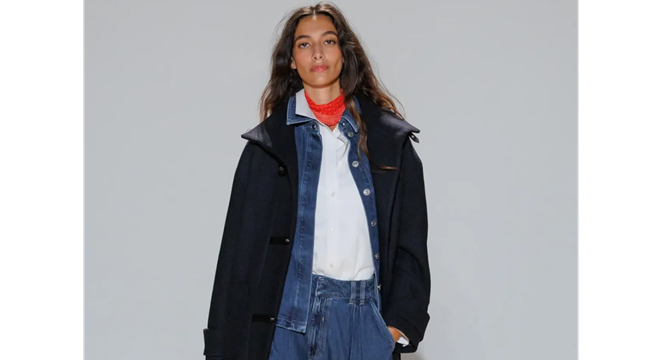
Denim Is Breaking Out Of The Blue Box For 2027–28
From super-blacks and chocolate browns to textured weaves, oversized silhouettes and water-saving technology, denim is entering a new phase. For mills and garment makers, the opportunity lies in turning these shifts into commercially viable products without compromising cost, comfort or sustainability.
Denim is moving well beyond
blue jeans. For Spring-Summer 2027 and 2028, the fabric is becoming heavier and
more structured in some applications, lighter and more fluid in others. Colours
are deepening, patterns are moving into the weave, and finishes are becoming
more distinctive. Meanwhile, new dyeing technologies are challenging the
industry's traditional dependence on water-intensive processing.
The signals come from
fabric launches at Denim City SP in Brazil and collections shown at London and
Paris fashion weeks. Together, they point to a market where fabric innovation,
garment design and production efficiency are increasingly connected.
For manufacturers, the
opportunity is clear: make denim do more, rather than simply make more denim.
Blue has competition
Indigo remains a staple,
but deep black, black-on-black, blue-black, olive, khaki and brown are
expanding the palette. Chocolate, coffee and cappuccino shades add
sophistication, while pale blue, pink, butter yellow, grape, water green and
red offer fresh summer options.
Colour treatments are
becoming more adventurous, too. Mills are experimenting with intense overdyes,
brown coatings over blue or black bases, contrasting warp and weft colours, and
combinations that reveal new shades after washing.
The commercial opportunity:
Mills can develop coordinated colour families and bases engineered for specific
wash effects. Garment makers and laundries can then create differentiated
products from a common fabric platform. The challenge is achieving consistent
shades and repeatable results at bulk scale.
Prints and textures move
into the weave
Polka dots, stripes,
florals, animal prints, paisley and camouflage are returning in fresh
combinations. But patterns are no longer confined to surface printing. Dobby
constructions, jacquard-like grids, herringbone, pinstripes and irregular
stripes are adding depth to denim and coloured twills.
Some constructions are
reversible, offering two looks from one fabric; others reveal new patterns
during washing. This gives mills a way to stand out in a crowded market while
helping apparel manufacturers create distinctive garments without relying heavily
on embroidery, appliqués or other add-ons.
The production test is
straightforward: complex patterns and textured surfaces must still cut, sew and
wash well. Seam appearance and dimensional stability need checking before a
striking swatch becomes a bulk order.
Rigid denim returns with
more body
Stretch has dominated many
denim categories, but rigid 100% cotton is reclaiming space. New offerings
include structured fabrics weighing 11–14 oz, alongside lighter cotton options
designed for softer drape and greater fluidity.
This is not simply a
revival of stiff, old-school jeans. Yarn selection, weave construction and
finishing are being used to balance body, softness and movement. Satin weaves
and specialised finishes can also give lightweight fabrics a substantial
appearance without making them feel heavy.
These constructions suit
wide-leg jeans, barrel-shaped trousers, oversized jackets, long shorts and
utility-inspired garments that need to hold their shape.
For garment makers, weight
alone is not enough. Drape, stiffness, seam bulk, shrinkage and wash response
will determine the final silhouette. Mills that provide performance data
alongside swatches can help customers make faster, better-informed decisions.
Stretch gets more
specialised
Not every denim product
needs the same level of elasticity. The market spans moderate-stretch fabrics
for everyday comfort and high-stretch constructions for close-fitting garments.
Recent launches range from products offering around 10% stretch to those
marketed with 30–47% stretch or power.
These figures are not
directly comparable: stretch percentage, elastane content and commercial
stretch or power ratings may use different measurement methods. Manufacturers
should check the test basis before comparing products.
Rigid-looking fabrics
containing small amounts of elastane offer another option, combining an
authentic denim appearance with added comfort.
Mills can sharpen their
product ranges by distinguishing rigid, comfort-stretch, high-stretch and
rigid-look stretch fabrics. Apparel makers should focus on recovery after wear,
knee bagging, dimensional stability and wash performance—not just the headline
stretch figure.
Denim changes shape
Fashion week collections
show denim moving beyond the conventional five-pocket jean. London's
Spring-Summer 2027 shows featured wide-leg jeans, flowing trousers, miniskirts,
elongated shorts and relaxed jackets, with twisted seams, visible stitching,
cut-outs and contrasting panels adding character.
Western references appeared
in dark washes, layered belts, paisley embroidery and studs. Punk influences,
tartan overlays and deconstructed designs pushed the fabric into more
experimental territory. White floral embroidery, printed surfaces and tulle softened
its rugged image, while unconventional pocket placement and mixed washes
reworked familiar details.
For manufacturers, these
silhouettes have direct fabric implications. Volume and structure call for body
and stability; flowing trousers need drape; cut-outs, twisted seams and mixed
panels demand careful pattern engineering and sewing. Fabric development should
follow the intended garment, not happen in isolation.
The wash becomes the
product
The wash room remains a
major source of differentiation, but the focus is shifting towards distinctive
and repeatable effects. Ultra-black, dirty washes, icy greys, crackled
surfaces, oily appearances, peach-like softness and contrasting overdyes are
widening the range. Laser technology can create polka dots and animal patterns,
while spray-gun pigmentation produces localised colour effects. Textured weaves
may reveal further detail after washing.
Some mills are also
developing fabrics designed to achieve a finished look with little or no
washing. This could cut processing time, handling, water and energy use—but the
economics depend on the complete production route.
For garment makers, the
priority is to test the fabric through actual finishing and garment production.
Any savings must be weighed against defect rates, shade consistency and the
work still needed to achieve the intended look.
The takeaway:
Denim's next phase will be shaped by more expressive colour and construction,
garment-led fabric development and smarter finishing. Manufacturers that
combine visual differentiation with reliable bulk performance—and can
demonstrate genuine processing savings—will be better placed to turn the trends
into business.
Sustainability moves into the
fabric itself
Denim's sustainability
story is becoming more concrete. Instead of relying only on claims about
responsible sourcing or improved finishing, mills and technology providers are
working on fibre composition, recycling, lower resource dyeing and designs that
require fewer processing steps.
One striking example comes
from Vicunha's Malva Juruá, a commercial denim developed with Amazonian mallow
fibre in partnership with Companhia Têxtil de Castanhal. The 7 oz fabric
combines cotton and mallow in a Panama construction. The mallow is cultivated
in Amazonian floodplains in alignment with natural river cycles, without
deforestation, artificial irrigation, pesticides or chemical fertilisers,
according to the source report.
Other developments include
recycled cotton, cotton-Lyocell blends and fabrics combining cotton, viscose,
linen and recycled fibres. Canatiba's lightweight Viscolino Éko Collor, for
instance, incorporates recycled cotton in a multi-fibre blend. Vicunha's Shelby
uses pre-consumer recycled cotton and a lower-water process.
The most striking example
is Stella McCartney's Spring 2027 collection, which featured denim made using
RCO100, a mechanical recycling technology from Swiss company Säntis Textiles.
The technology recovers cotton fibres from pre- and post-consumer textile waste
without water or chemicals during the refining stage.
For denim manufacturers,
the challenge is to move beyond simply adding recycled content. Fibre length
and strength, yarn quality, fabric durability, shade consistency and cost all
influence whether a sustainable material can work commercially at scale.
Waterless dyeing could
change the economics
Biotechnology company
WTRLSS has launched a digital dyeing technology that it says can reduce water
use in denim dyeing and finishing by up to 99.9%. According to the company's
announcement, conventional processing uses approximately 75 litres of water per
pair of jeans for dyeing and finishing, compared with around two tablespoons
using its technology. The company also reports a 90% reduction in energy
consumption.
WTRLSS combines bioscience
and digital technology in a simplified, single-step dyeing process. The company
says the approach is designed to maintain denim quality while reducing resource
use and manufacturing costs. Bangladesh's Ha-Meem Group has partnered with
WTRLSS on a commercial production pilot, signalling interest in taking the
technology beyond laboratory development.
The potential business
benefits extend beyond environmental performance. Lower water demand could
reduce water procurement, wastewater treatment and recycling costs, while
making denim production more feasible in locations where water availability is
a constraint.
But technology claims need
to be tested on the factory floor. Mills and garment manufacturers will need to
assess shade reproducibility, colour fastness, compatibility with existing
machinery, throughput, chemical inputs and total cost per metre or garment.
Pilot results and independent performance data will be important before
committing to large-scale adoption.
The wider direction is
clear: resource efficiency is becoming a manufacturing capability, not merely a
sustainability talking point.
The winners in denim's next
cycle will be those who connect fabric innovation with garment design,
manufacturing efficiency and measurable sustainability, not those who simply
follow the next colour trend.
The wider direction is clear: resource efficiency is becoming a manufacturing capability, not merely a sustainability talking point. The winners in denim's next cycle will be those who connect fabric innovation with garment design, manufacturing efficiency and measurable sustainability, not those who simply follow the next colour trend.
Subscribe To Textile Excellence Print Edition
If you wish to Subscribe to Textile Excellence Print Edition, kindly fill in the below form and we shall get back to you with details.
Newsletter
Subscribe To Textile Excellence Mailing List

- December 09, 2022
'There Is Very High Acceptance For India

- December 09, 2022
'Advanced Machines & Service, Customer C
- October 09, 2023
First-time In The World: Rieter’s Auto
- July 28, 2026
Arvind Eyes Leadership In India's Premiu
- June 01, 2020
Karl Mayer Enables Automated Production
- June 05, 2023
Ultimax - All New Revolutionary Rapier W
- June 09, 2025
DyStar Becomes A Wholly Owned Subsidiary

- July 28, 2026