
Fashion For Good’s Cotton Reloop Matrix Project Will Try To Scale Cotton Recycling
The
Cotton Reloop Matrix Project will test recycled cotton yarns against real-world
brand requirements, helping the industry understand the trade-offs between
quality, price and recycled content.
Recycled
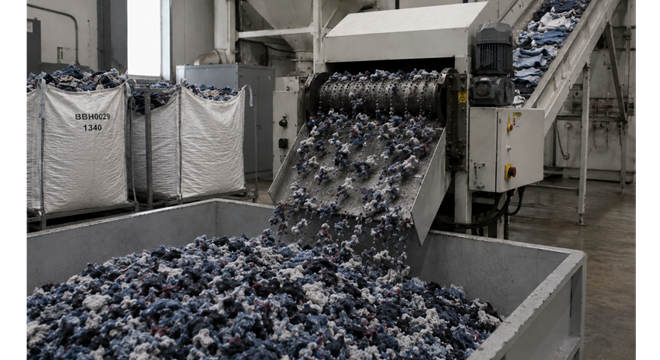
cotton has a scale problem. Mechanical recycling can turn textile waste into
new fibres, but the process shortens and weakens the fibres, limiting how much
recycled cotton can be blended into new yarn without affecting fabric
performance.
Fashion
for Good’s new Cotton Reloop Matrix Project aims to tackle this challenge with
data, mill trials and shared quality standards. The initiative will map the
capabilities of commercially available recycled cotton yarns against brand
specifications and physically validate their performance, giving the industry a
clearer picture of where recycled cotton is commercially viable today and what
it will take to use more of it.
The
project brings together Fashion for Good partners Arvind, BESTSELLER, C&A,
Interloop, Reformation and Shahi, with ecosystem partner Uster contributing its
yarn-testing expertise.
Why
recycled cotton remains a challenge
Cotton
accounts for 19% of global fibre production, making its recovery an important
part of textile circularity. Mechanical recycling offers a way to turn
cotton-rich textile waste into new yarns and fabrics. The process shreds waste
into loose fibres that can be respun, but only around 45%–50% of the input
survives as usable material. The rest is lost as short fibres and processing
waste.
The
recovered fibres are also shorter than virgin cotton, limiting the proportion
that can be blended into new yarn. As a result, many recycled cotton yarns are
restricted to around 10% recycled content if the fabric is to meet commercial
performance requirements.
Recyclers
may have capacity available, but brands still face difficult choices over
quality, price and recycled content. Testing is often fragmented, with brands
and recyclers working from separate datasets and lacking a common basis for
comparison. Recycled blends are also frequently measured against 100% virgin
cotton benchmarks, which may not reflect what recycled fibres can realistically
deliver.
The
project aims to shift the focus from matching virgin cotton in every respect to
finding the right recycled blend for each application, with targeted quality
improvements where higher performance is needed.
“Recycled
cotton has been talked about as a scale-ready solution for years, but the
industry has been working from fragmented data and siloed testing,” said Katrin
Ley, Managing Director at Fashion for Good. “This project is about closing that
gap with hard evidence. By plotting real recycler capabilities against real
brand quality targets, and by co-developing the operational standards to
support them, we can move recycled cotton from a case-by-case experiment to a
category the industry can actually plan around.”
From
data to mill trials
The
project will run on two parallel tracks.
First,
Fashion for Good will map what recyclers can currently produce against brand
requirements for knitted and woven fabrics. The resulting Quality Matrix will
identify where recycled cotton is ready for commercial use and where further
innovation is needed.
Second,
selected recyclers and project partners will produce 10 demonstrator fabrics
and conduct five quality-augmentation trials under real production conditions.
These trials will generate a Trade-off Analysis showing how recycled content,
price and quality affect one another.
The
findings will feed into an open-source spinning Standard Operating Procedure
(SOP), aimed at helping manufacturers achieve more consistent results across
supply chains. The project will culminate in a Roadmap for Cotton
Circularity, outlining the data infrastructure needed to scale recycled
cotton across product categories and regions.
“Recycled
cotton isn't new to us: it's a fibre we've worked with for years. What's been
limiting is the ability to scale to higher blend percentages without
compromising fabric quality or hand-feel. What this project offers is a shared
reference point where brands and recyclers work from the same evidence. We hope
this opens the door to greater scalability and uptake over time,” said Nikki
Player, Senior Director of Raw Materials at Reformation.
By
bringing brands, manufacturers and recyclers onto a common testing platform,
the project aims to replace isolated trials with a more practical,
evidence-based route to commercial adoption.
“Recycled cotton isn't new to us: it's a fibre we've worked with for years. What's been limiting is the ability to scale to higher blend percentages without compromising fabric quality or hand-feel. What this project offers is a shared reference point where brands and recyclers work from the same evidence. We hope this opens the door to greater scalability and uptake over time,” said Nikki Player, Senior Director of Raw Materials at Reformation.
Subscribe To Textile Excellence Print Edition
If you wish to Subscribe to Textile Excellence Print Edition, kindly fill in the below form and we shall get back to you with details.
Newsletter
Subscribe To Textile Excellence Mailing List


- December 09, 2022
'There Is Very High Acceptance For India

- December 09, 2022
'Advanced Machines & Service, Customer C
- October 09, 2023
First-time In The World: Rieter’s Auto

- July 28, 2026
Arvind Eyes Leadership In India's Premiu

- June 01, 2020
Karl Mayer Enables Automated Production
- June 05, 2023
Ultimax - All New Revolutionary Rapier W
- June 09, 2025
DyStar Becomes A Wholly Owned Subsidiary

- July 28, 2026