

India Bets Big On Cotton As Global Supply Tightens
India is making its biggest cotton push in years. The Centre has approved a massive Rs 5,659.22 crore “Mission for Cotton Productivity” to revive yields, improve quality and make India self-reliant in cotton by 2030-31. The timing is critical. Global cotton demand is rising Global cotton demand is rising again. Consumption is expected to touch 121.7 million bales in 2026/27 — the highest level in six years. At the same time, global production is forecast to fall 5 percent to 116 million bales. The result: tightening supplies, falling stocks and a growing scramble for quality cotton. India wants to capture that opportunity before competitors do. India’s targets 498 lakh bales production by 2031 The new mission aims to raise India’s cotton production to 498 lakh bales by 2031. The government also plans to sharply improve lint productivity from the current 440 kg per hectare to 755 kg per hectare. This is not just an agriculture scheme. It is a strategic textile and trade play. The mission fits into the government’s larger 5F strategy — Farm to Fibre to Factory to Fashion to Foreign. The message is clear: India wants to strengthen its position in the global textile supply chain at a time when the world is looking for stable cotton suppliers. The global backdrop is turning favourable for cotton. More wars, more shopping, less cotton inventories drive demand One major reason is the ongoing oil supply disruption linked to tensions in the Middle East. Polyester and other synthetic fibres depend heavily on petrochemical feedstock. As oil prices rise and supply becomes volatile, polyester costs are climbing. This is narrowing the price gap between cotton and synthetics. The ripple effects are already visible across the textile chain. Global cotton demand is now being supported by stronger apparel consumption in major markets such as the United States, China and the European Union. U.S. clothing retail sales grew 8 percent in 2025. China’s domestic apparel demand also remained resilient despite slower economic growth. Meanwhile, EU cotton product imports hit a record high in 2025. The market is also entering a stock drawdown cycle. Global ending stocks are forecast to fall sharply from 77.3 million bales in 2025/26 to 71.8 million bales in 2026/27. Stocks are expected to decline in major consuming countries including China, India and the United States. China is quietly reducing cotton acreage According to the China Cotton Association’s April 2026 sowing survey, China’s cotton planting area is estimated at 43.066 million mu, down 3.9 percent year-on-year. The biggest shift is happening in Xinjiang, China’s dominant cotton belt. Xinjiang’s cotton area is expected to decline 3.5 percent to 39.464 million mu as authorities systematically withdraw low-yield farmland and water-stressed cotton fields. The Yangtze River Basin is seeing an even steeper decline. Cotton acreage there is projected to fall 15.6 percent year-on-year. China’s reduction matters because it remains one of the world’s largest cotton consumers. Even if production falls, its domestic mills continue to need large volumes of fibre. That creates room for other producing countries to expand exports. India steps in to meet future higher demand for cotton Under the new mission, the government will focus initially on 140 districts across 14 states. Around 32 lakh farmers are expected to benefit. The programme goes beyond seeds and farming. The government plans to develop high-yielding, climate-resilient and pest-resistant cotton varieties. It will aggressively promote High Density Planting System (HDPS), closer spacing methods and Integrated Cotton Management practices. There is also a major push for Extra Long Staple (ELS) cotton, an area where India still depends heavily on imports despite being one of the world’s largest cotton producers. Quality is another big focus area. India has long struggled with contamination and inconsistent fibre quality. The mission targets trash content below 2 percent and plans large-scale modernization of 2,000 ginning and processing factories. Testing infrastructure will also be upgraded with standardized and accredited cotton testing facilities to improve global benchmarking. The government is also doubling down on branding through Kasturi Cotton Bharat. The initiative focuses on traceability and certification to position Indian cotton as a premium and sustainable fibre in global markets. Digital integration of mandis, transparent price discovery and e-platform access are also part of the roadmap. Focus on sustainable, natural fibres Another important element is sustainability. The mission includes promotion of cotton waste recycling and circular economy practices. It also seeks to diversify India’s fibre base through natural fibres such as flax, ramie, sisal, bamboo, banana and milkweed. The strategy reflects changing global sourcing trends. International brands are increasingly demanding traceable, sustainable and low-contamination fibre. India wants to move beyond being just a volume player and become a preferred sourcing destination. The numbers explain why the government is moving aggressively now. Global consumption in 2026/27 is projected to exceed production by nearly 5.7 million bales. Among the top five consuming countries, all are expected to record higher cotton use. Meanwhile, Brazil and the United States will continue dominating exports. Brazil alone is expected to export a record 15 million bales next season. India cannot afford stagnant productivity in such an environment. The country remains one of the world’s largest cotton producers, but yields have lagged global competitors for years due to pest attacks, fragmented farming and uneven technology adoption. The new mission is an attempt to reverse that trend before the next global cotton upcycle fully takes shape. If India succeeds in lifting productivity and improving quality, it could emerge as one of the biggest beneficiaries of tightening global cotton supplies, rising demand and shifting trade dynamics.
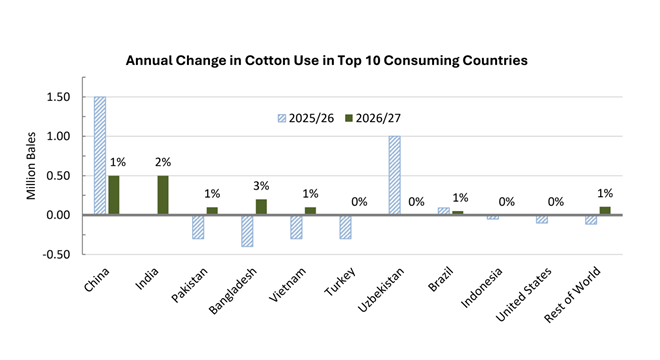
India cannot afford stagnant productivity in such an environment. The country remains one of the world’s largest cotton producers, but yields have lagged global competitors for years due to pest attacks, fragmented farming and uneven technology adoption. The new mission is an attempt to reverse that trend before the next global cotton upcycle fully takes shape. If India succeeds in lifting productivity and improving quality, it could emerge as one of the biggest beneficiaries of tightening global cotton supplies, rising demand and shifting trade dynamics.
Subscribe To Textile Excellence Print Edition
If you wish to Subscribe to Textile Excellence Print Edition, kindly fill in the below form and we shall get back to you with details.
Newsletter
Subscribe To Textile Excellence Mailing List


- December 09, 2022
'There Is Very High Acceptance For India

- December 09, 2022
'Advanced Machines & Service, Customer C
- October 09, 2023
First-time In The World: Rieter’s Auto

- July 28, 2026
Arvind Eyes Leadership In India's Premiu

- June 01, 2020
Karl Mayer Enables Automated Production

- June 05, 2023
Ultimax - All New Revolutionary Rapier W

- June 09, 2025
DyStar Becomes A Wholly Owned Subsidiary

- July 28, 2026