
Textiles Summit 2026 Charts National Roadmap To Achieve US$100 Billion Textile Exports By 2030
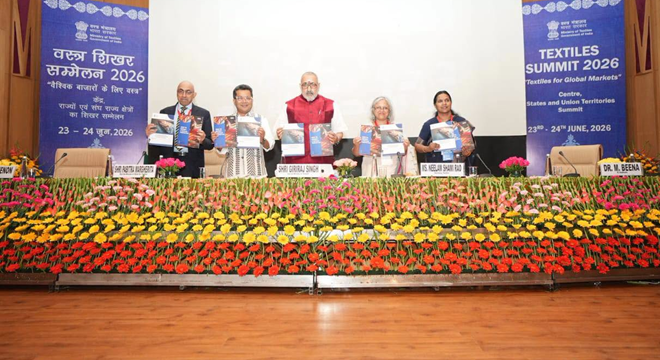
The Ministry of Textiles concluded the two day Textiles Summit 2026 in New Delhi after laying the foundation for a comprehensive National Textile Export Roadmap 2030, aimed at increasing India's textile and apparel exports from around US$37 billion to US$100 billion by 2030. Organised under the Cabinet Secretariat's Departmental Summit initiative, the event reinforced cooperative federalism by bringing together representatives from 36 States and Union Territories, district administrations, Export Promotion Councils, industry associations, exporters, financial institutions, academia and policymakers.
The summit was the culmination of an extensive nationwide consultation process involving 36 State and Union Territory consultations, nearly 200 district level consultations, and participation from over 5,000 stakeholders. This exercise resulted in the preparation of 36 State Export Action Plans (SEAPs) and 200 District Export Action Plans (DEAPs), establishing a decentralised framework to strengthen India's textile export ecosystem.
Guided by Prime Minister Narendra Modi's vision of "Farm to Fibre, Fibre to Factory, Factory to Fashion and Fashion to Foreign," the summit focused on creating a coordinated strategy to enhance India's competitiveness across the global textile and apparel value chain.
Addressing the inaugural session, Union Textiles Minister Giriraj Singh highlighted the importance of district led export growth, product diversification, technical textiles, value addition, branding, sustainability, skilling and improved market access. During the concluding session, he stressed that the time had come to implement the State and District Export Action Plans through proactive execution, while focusing on the right product market mix, compliance with sustainability standards, greater utilisation of Free Trade Agreements, and development of niche textile products.
Textiles Secretary Neelam Shami Rao emphasised that the summit marked a transition from dialogue to implementation. She stated that recommendations received from States, districts, industry stakeholders and Export Promotion Councils would now be consolidated into the National Textile Export Roadmap 2030. The roadmap will prioritise high value manufacturing, innovation, sustainability, institutional coordination and export competitiveness.
Minister of State for Textiles Pabitra Margherita called upon State Governments to become stronger catalysts for export growth through decentralised planning, product diversification, value addition and brand creation.
A special address by Commerce Secretary Rajesh Agrawal urged exporters to maximise benefits from recently concluded Free Trade Agreements at the earliest. He emphasised the need to eliminate information gaps at the district level, strengthen the Districts as Export Hubs initiative, and enhance awareness regarding export opportunities. He also appreciated the publication "Leveraging India's Recent FTAs: A Textiles Perspective", noting that the Department of Commerce has already conducted nearly 500 awareness workshops across the country.
The summit featured five comprehensive thematic sessions covering every critical aspect of export competitiveness. Discussions examined district and cluster led export strategies through successful textile clusters including Ludhiana, Tiruppur, Surat and Bhadohi, while identifying pathways to strengthen competitiveness and respond to changing global demand, particularly the growing shift towards man made fibres (MMF).
Another major focus area was product innovation, design enhancement, technical textiles, traceability, branding and material innovation. The Northeast's Geographical Indication products, luxury textiles including Pashmina, rural cooperatives and entrepreneurial success stories demonstrated India's growing emphasis on heritage based value addition and globally differentiated products.
Participants also deliberated on key export enablers including logistics, export finance, PM MITRA Parks, technology adoption, labour compliance, infrastructure development, State incentives, risk mitigation mechanisms and integrated manufacturing ecosystems. Successful State level policy models showcased how coordinated infrastructure and industrial development can accelerate export competitiveness.
Sustainability emerged as a central pillar of future export growth. Deliberations highlighted digital product passports, circular economy practices, closed loop recycling systems, textile waste management, simplified sustainability compliance for MSMEs, stronger collaboration between municipalities and State Governments, and harmonisation of Indian standards with evolving global regulatory frameworks.
The final session focused on export enablement, Free Trade Agreement utilisation and market diversification. Industry leaders emphasised improving ease of doing business, attracting anchor investors, expanding export finance, strengthening in house design capabilities, building globally competitive Champion MSMEs, promoting Brand India internationally and accelerating the transition towards higher value MMF based products.
The Ministry also released two important publications during the summit titled "Leveraging India's Recent FTAs: A Textiles Perspective" and "How to Export: A Textiles Perspective", providing exporters practical guidance to enhance international market access.
Recommendations emerging from the summit will now shape India's long term export strategy, strengthening district and cluster ecosystems, promoting value added manufacturing, increasing utilisation of Free Trade Agreements, advancing sustainability, encouraging innovation and positioning India among the world's preferred textile sourcing destinations. The National Textile Export Roadmap 2030 is expected to serve as the country's blueprint for achieving its ambitious US$100 billion textile export target while building a resilient, technology driven and globally competitive textile industry.
Recommendations emerging from the summit will now shape India's long term export strategy, strengthening district and cluster ecosystems, promoting value added manufacturing, increasing utilisation of Free Trade Agreements, advancing sustainability, encouraging innovation and positioning India among the world's preferred textile sourcing destinations. The National Textile Export Roadmap 2030 is expected to serve as the country's blueprint for achieving its ambitious US$100 billion textile export target while building a resilient, technology driven and globally competitive textile industry.
Subscribe To Textile Excellence Print Edition
If you wish to Subscribe to Textile Excellence Print Edition, kindly fill in the below form and we shall get back to you with details.
Newsletter
Subscribe To Textile Excellence Mailing List


- December 09, 2022
'There Is Very High Acceptance For India

- December 09, 2022
'Advanced Machines & Service, Customer C
- October 09, 2023
First-time In The World: Rieter’s Auto

- July 28, 2026
Arvind Eyes Leadership In India's Premiu

- June 01, 2020
Karl Mayer Enables Automated Production

- June 05, 2023
Ultimax - All New Revolutionary Rapier W

- June 09, 2025
DyStar Becomes A Wholly Owned Subsidiary

- July 28, 2026