
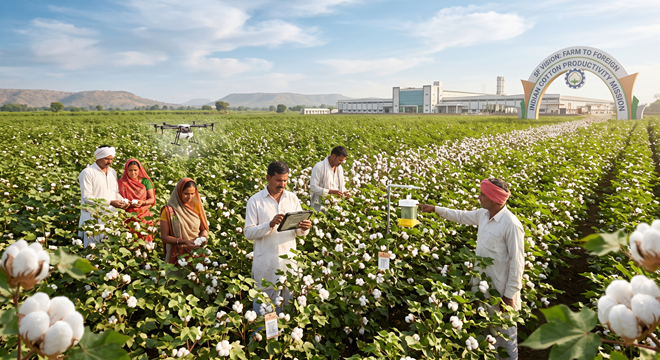
₹5,600 Crore Cotton Mission Signals Biggest Productivity Push In Years
India
is betting big on cotton.
Just
as cotton sowing stages a strong comeback after a delayed monsoon, the Union
Cabinet has cleared the ₹5,600 crore Mission for Cotton Productivity, one of
the country's biggest investments in the fibre sector in recent years.
The
mission targets the biggest challenges holding back India's cotton industry:
low yields, pest attacks and inconsistent fibre quality. The goal is ambitious
- to raise cotton production to 498 lakh bales by 2030-31 while strengthening
the country's textile value chain from farm to finished products.
The
programme will develop high-yielding, pest- and disease-resistant cotton
varieties, accelerate the adoption of modern farming technologies and improve
farm productivity. Around 32 lakh cotton farmers are expected to benefit.
The
initiative forms a key part of the Government's 5F vision - Farm to Fibre,
Fibre to Factory, Factory to Fashion and Fashion to Foreign, placing cotton at
the centre of India's textile growth strategy.
From
more acres to more cotton
The
announcement comes as India's cotton outlook improves dramatically.
After
weeks of delayed rains, sowing has accelerated across major cotton-growing
states. Industry now expects the country to comfortably achieve the
government's target of 125-130 lakh hectares, helped by higher MSP, better
market prices and farmers shifting from soybean, maize, sugarcane and groundnut
to cotton.
But
bigger acreage alone will not secure India's cotton future.
India
continues to trail several major cotton-producing nations in productivity.
Unless yields improve, the country will struggle to meet the growing raw
material requirements of its spinning, weaving and apparel sectors.
The
new mission is designed to bridge that gap.
Early
pest warning raises stakes
The
timing is significant for another reason.
Even
as sowing gathers pace, the first reports of whitefly and pink bollworm have
emerged from Punjab's cotton belt. While infestations remain below economic
threshold levels, agriculture departments and scientists have stepped up field
surveillance and urged farmers to closely monitor crops over the coming weeks.
Experts
have recommended integrated pest management and warned against indiscriminate
pesticide spraying, while expected rainfall could help naturally reduce
whitefly populations.
A
big win for India's textile industry
India
is no longer focusing only on expanding cotton acreage, it is now investing in
producing more cotton per hectare, better-quality fibre and a more resilient
crop.
If
successfully implemented, the Cotton Productivity Mission could strengthen raw
material availability, improve fibre quality, reduce dependence on imports and
enhance the global competitiveness of India's spinning, textile and apparel
industries.
The
next phase of India's cotton story will not be driven by acreage alone, but by
productivity.
India is no longer focusing only on expanding cotton acreage, it is now investing in producing more cotton per hectare, better-quality fibre and a more resilient crop. If successfully implemented, the Cotton Productivity Mission could strengthen raw material availability, improve fibre quality, reduce dependence on imports and enhance the global competitiveness of India's spinning, textile and apparel industries. The next phase of India's cotton story will not be driven by acreage alone, but by productivity.
Subscribe To Textile Excellence Print Edition
If you wish to Subscribe to Textile Excellence Print Edition, kindly fill in the below form and we shall get back to you with details.
Newsletter
Subscribe To Textile Excellence Mailing List


- December 09, 2022
'There Is Very High Acceptance For India

- December 09, 2022
'Advanced Machines & Service, Customer C
- October 09, 2023
First-time In The World: Rieter’s Auto

- July 28, 2026
Arvind Eyes Leadership In India's Premiu

- June 01, 2020
Karl Mayer Enables Automated Production
- June 05, 2023
Ultimax - All New Revolutionary Rapier W

- June 09, 2025
DyStar Becomes A Wholly Owned Subsidiary

- July 28, 2026